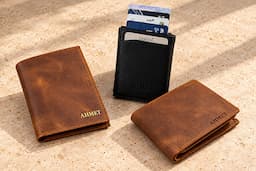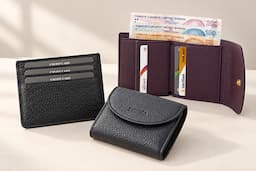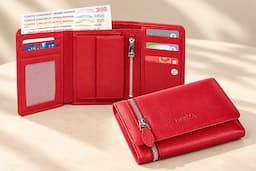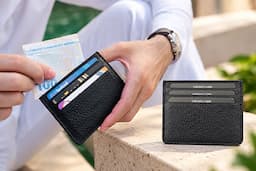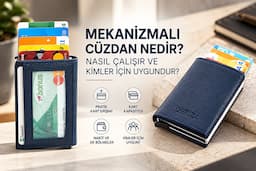


Where should you start when choosing a men’s leather wallet?
Quick answer: Start with the cards, banknotes and coins you carry each day, where you keep your wallet and which compartments you need. Then compare vertical and horizontal designs, closed dimensions, thickness when filled, leather and lining information. The right wallet holds your daily essentials without forcing them into place and feels convenient to use.
Empty your current wallet first. Separate everyday cards from spare cards, banknotes, coins and documents. Choosing extra compartments for items you rarely use may leave you carrying unnecessary bulk every day.
1. List your everyday cards and cash
Count your identification, driving licence, payment and travel cards according to your routine. Consider whether frequently used cards need individual access. Carrying several cards requires a practical layout as well as enough slots.
The number of card slots is not the same as tested total capacity. Embossed, metal or thicker cards, slot construction and overlapping compartments can affect bulk. Follow the manufacturer’s capacity guidance. Do not force extra cards into a slot in the hope that the leather will stretch.
For cash, consider the number of banknotes and the currency you use, not just their total value. If you regularly receive change, look for a coin compartment that closes. Not every traditional wallet has one.
2. Vertical or horizontal wallet?
Vertical and horizontal describe the wallet’s closed format and design. Turning a wallet to insert banknotes does not change its format.
For either design, assess closed width, height, opening direction and card-slot arrangement together. Being able to retrieve the wallet and reach a frequently used card matters as much as fitting it into your pocket.
There is no general rule that horizontal wallets hold more cards or vertical wallets are thinner. Actual dimensions and compartment layout should guide your choice.
3. Why dimensions and loaded thickness matter
Check whether the listed dimensions describe the wallet open or closed. Width and height help you assess pocket fit, but an empty thickness measurement, or one with unspecified contents, does not establish its thickness in daily use.
Cards, folded banknotes, coins, closures and overlapping leather pieces all affect bulk. For front-pocket use, measure your current wallet with your everyday contents as a useful reference.
For a jacket pocket, consider its depth and opening. In a bag, check how easily you can retrieve the wallet with other items in place. “Mini” or “slim” is not a guarantee of comfortable use.
Distinguish external dimensions from usable internal space. Seams, edges and fold allowances can make a compartment’s usable dimensions different from the wallet’s outer measurements.
4. Inspect banknote, coin and transparent compartments
What should you check in a banknote compartment?
If you prefer unfolded banknotes, check the usable internal dimensions and how notes are inserted. The wallet’s external length does not prove that every banknote you use will fit flat. Two note compartments may help separate currencies or receipts, but not everyone needs that separation.
Do you need a coin pocket?
If you use coins every day, a purpose-built compartment with a flap or zip can be useful. An unused coin pocket may add bulk, depending on the wallet’s construction.
What should you check in a transparent ID compartment?
Check that the compartment suits the actual dimensions of your identification document and how it needs to be inserted. Do not count it as additional card capacity unless the manufacturer specifies this.
5. Is a zipped men’s wallet practical?
A zip may close the entire wallet, a single internal compartment or a coin pocket. Check which area it closes, how far it must open to remove a card or banknote, and whether it closes without strain when filled.
A zip does not establish that a compartment is designed for coins. Check its intended use in the product description. A zip alone does not make a wallet waterproof either.
6. How to assess leather, lining and construction
Look beyond “genuine leather” to the stated leather type and other materials. The Deriza examples below are listed as cowhide. However, leather type alone does not determine finished quality or service life.
Leather thickness and overlapping parts
The outer body, card pockets and banknote compartments can overlap. Leather thickness, surface finish, fold construction and component placement need to work together.
Controlled thinning and edge skiving may be used on selected parts during production. The aim is to reduce unnecessary bulk while maintaining suitable strength, rather than making every piece as thin as possible. Thicker leather is not automatically better in every part of a wallet.
Why does lining matter?
A leather exterior does not mean every internal compartment is leather. Read the lining specification separately. When inspecting a wallet, check that the lining sits neatly, that its joins are finished and that cards or notes do not catch during removal. No single lining material is best for every design.
What should you look for in stitching and edges?
Look for consistent stitching, aligned card pockets, finished edges and a fold that moves without strain. More stitching or more components do not, by themselves, prove better quality.
7. Comparing two Deriza designs
The following details come from product listings. Dimensions are closed width and height; they are not results from a physical use test or measurements of loaded thickness.
| Model | Format and closed dimensions | Compartments |
|---|---|---|
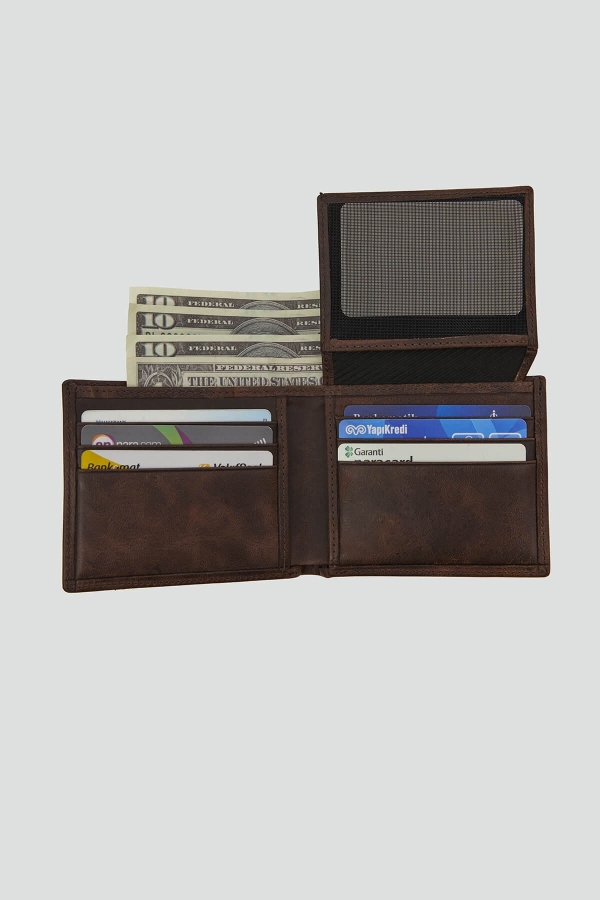
| Loris Taba — DRZ5719 | Horizontal; 11 × 9.5 cm | 6 card slots, 1 transparent compartment and 2 banknote compartments. No coin pocket. |
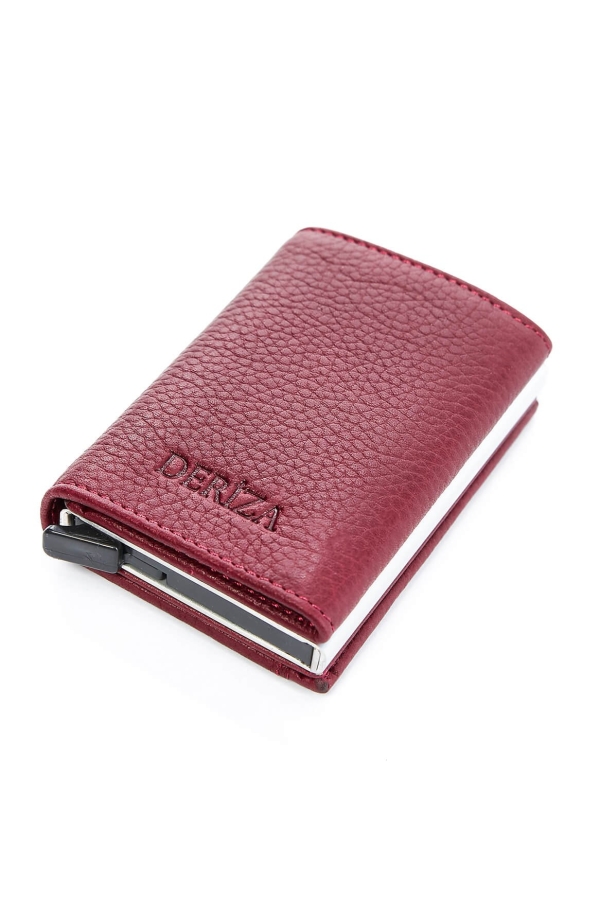
| Mini Dikey Vizon — DRZ5700 | Vertical; 8 × 10.5 cm | 7 card slots, 1 transparent compartment and 1 banknote compartment. No coin pocket. |
In these examples, the narrower model has more card slots. This does not establish greater total capacity or better pocket comfort. The arrangement of everyday contents and performance when filled require separate assessment.
8. Which design suits your routine?
I carry few cards and use a front pocket
Start with closed dimensions and loaded thickness. If you carry little cash, consider men’s leather card holders as well. Check whether you need to remove other cards to reach a frequently used one.
I carry several cards but want to avoid a bulky wallet
Identify the cards you need every day, then compare overlapping pockets and the closure. Extra compartments may improve organisation, but they do not automatically reduce thickness when filled.
I use banknotes and coins
Prioritise banknote access, a coin compartment and a closure that works without strain. Neither of the two models above has a coin pocket, so this requirement calls for a different compartment layout.
I prefer a card-ejection mechanism
When comparing pop-up wallets, assess supported card types and chamber capacity separately from external slots and cash storage. A mechanism does not establish RFID protection; that feature must be specified for the individual model.
If you also want to carry a phone, screen size is not enough. Compare the phone’s width, height and thickness with its case against the compartment’s usable internal dimensions. Without this information, compatibility cannot be confirmed.
9. Common wallet-buying mistakes
- Relying on photographs without checking closed dimensions.
- Treating the slot count as guaranteed total capacity.
- Inferring banknote, document or phone fit from external dimensions.
- Assuming thickness or capacity from vertical or horizontal format.
- Choosing unnecessary compartments simply because there are more of them.
- Inferring RFID protection, waterproofing or lifespan from leather type.
Colour, leather appearance and care
Choose the colour after considering practical needs. Black, brown, tan, navy and other shades are personal preferences; a wallet does not have to match your belt and shoes exactly.
Leather can change in appearance and feel according to use and its surface finish. Not every leather develops the same patina, and patina alone is not a quality measure. Do not rely on smell, touch or a water-drop test to conclusively identify genuine leather. Check the material description and avoid destructive methods such as burning.
- Do not fill the wallet beyond its stated capacity.
- Protect it from heavy water exposure and direct heat.
- Do not dry a wet wallet with a radiator or hairdryer.
- Do not apply alcohol-based cologne or harsh cleaners directly.
- Follow the manufacturer’s care instructions for the leather and finish.
- Test a suitable care product on a small hidden area first.
Your final checklist before buying
- List your daily cards, banknotes, coins and documents.
- Compare closed dimensions with your pocket or bag.
- Read compartment counts and stated capacity separately.
- Check the purpose of any transparent compartment and zip.
- Inspect leather, lining, stitching, edges and closure construction.
- Ask for model-specific information when loaded thickness or fit is unclear.
Compare Deriza men’s leather wallets according to your card, banknote and coin needs. Choose a model that organises your everyday essentials without strain, feels comfortable to carry and is convenient to use.





Merhaba Deri Tutkunları!
Ben Recep AYCAN, Ege Üniversitesi Deri Mühendisliği mezunu bir deri mühendisiyim. 🎓 Bu blog sayfasında, deriyle ilgili merak edilen her şeyi, en detaylı ve keyifli şekilde sizlerle paylaşacağım. Umarım içeriklerimden keyif alırsınız! 😊 📧 Bana Ulaşın Sorularınız için her zaman destek@deriza.com adresinden bana yazabilirsiniz. Keyifli okumalar dilerim!