

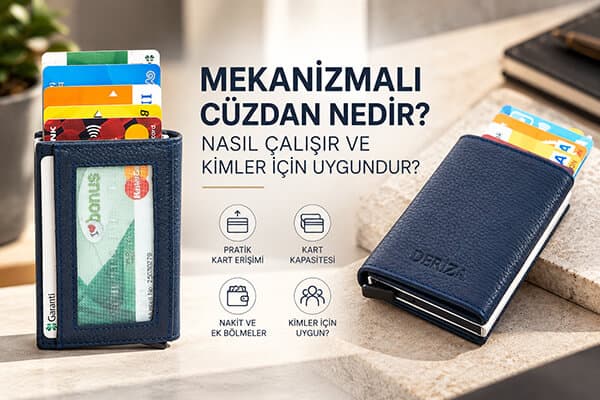
What Is a Mechanism Wallet? How Does It Work and Who Is It For?
Quick answer: A mechanism wallet is a type of wallet in which cards are stored together inside a dedicated chamber and moved into a more accessible position when the mechanism is activated. Some models focus mainly on carrying cards, while others may also include a genuine leather outer body, additional card slots and space for banknotes. When choosing the right model, consider not only the mechanism but also the number of cards you carry, your use of cash, the actual dimensions of the wallet and any additional compartments.
As bank cards, credit cards, identification cards and other cards have become part of everyday life, alternatives to traditional wallets have also become more common. The mechanism wallet is one of these alternatives.
The defining feature of this type of wallet is that it provides access to cards through a mechanism instead of requiring each card to be removed individually from a conventional card slot. However, not all mechanism wallets are the same. Card capacity, mechanism design, outer body, leather sections, banknote storage and overall dimensions can vary by model.
For this reason, the first question should not simply be “Does it have a mechanism?” but rather “Does this mechanism wallet suit the way I carry my everyday essentials?”
What Is a Mechanism Wallet?
A mechanism wallet is a wallet structure in which cards are stored inside a dedicated chamber and moved upward into a more accessible position when the mechanism is activated.
In traditional wallets, cards are generally placed in separate card slots. In mechanism models, a certain number of cards can instead be carried together inside the mechanism chamber.
Depending on the model, additional features may include:
- Additional card slots,
- A banknote compartment,
- A transparent compartment,
- A coin compartment,
- A genuine leather outer covering or body,
- Different closure systems.
Therefore, “mechanism wallet” does not refer to one single design. It describes different wallet structures that use a mechanism to provide easier access to cards.
How Does a Mechanism Wallet Work?
The basic principle is relatively simple. Cards are placed inside the card chamber of the mechanism. When the mechanism is activated, the cards move upward so that they become easier to access and select.
The exact operating system can vary between products. It should not be assumed that every model uses the same lever, button, mechanism material or card-release design.
A typical usage sequence is:
- Place the cards inside the mechanism chamber.
- Activate the wallet mechanism.
- The cards move into a more accessible position.
- Select the card you need.
- Return the card to the chamber after use.
This structure can provide an alternative to traditional card slots, particularly for people who frequently access their cards during the day.
What Is the Difference Between a Mechanism Wallet and a Traditional Wallet?
The main difference is how the cards are stored and accessed.
| Feature | Mechanism Wallet | Traditional Wallet |
|---|---|---|
| Card access | The mechanism moves cards into an accessible position | Cards are generally removed manually from individual slots |
| Card arrangement | Some of the main cards can be stored together inside the mechanism | Cards are generally distributed across separate card slots |
| Structure | Mechanism plus, depending on the model, a leather body and additional compartments | Traditional folding or other wallet constructions |
| Cash storage | A banknote compartment may or may not be included depending on the model | Many models include a banknote compartment |
| Capacity | Depends on the mechanism and additional compartments | Depends on the number and arrangement of card, banknote and other compartments |
| Suitable for | People who want quicker card access and organized card storage | People who prefer a traditional wallet layout |
Neither structure is universally better. The right choice depends on what you actually carry every day.
How Many Cards Does a Mechanism Wallet Hold?
There is no single standard card capacity for mechanism wallets. Capacity can vary according to the mechanism, card thickness, whether the cards are embossed and the number of additional card slots in the wallet.
For this reason, it would be inaccurate to claim that all mechanism wallets hold a fixed number of cards.
It is useful to distinguish between two types of capacity:
- Mechanism capacity: The number of cards that can be carried inside the mechanism chamber.
- Total wallet capacity: The number of cards that can be carried in the mechanism plus any additional internal or external card slots.
The physical structure of the cards also matters. Thick, metal or embossed cards may occupy a different amount of space than standard flat cards.
When evaluating a Deriza model, the actual capacity and compartment information provided for that specific product should therefore be used as the reference.
Is a Mechanism Wallet Practical?
Whether a mechanism wallet is practical depends on your everyday carrying habits.
For people who frequently use bank or credit cards, want to keep their cards organized in one place and value quick access, a mechanism structure can be convenient.
However, someone who regularly carries many receipts, documents, coins or differently sized items may find that a compact card-focused model does not provide enough storage.
The most useful answer to “Is a mechanism wallet practical?” is therefore:
It can be practical when the cards, cash and other items you carry match the structure of the model you choose.
Who Is a Mechanism Wallet Suitable For?
A mechanism wallet may be worth considering for people who:
- Use cards frequently throughout the day,
- Want faster access to their cards,
- Prefer to keep their main cards organized inside one mechanism,
- Want an alternative to traditional multi-slot wallets,
- Prefer a compact wallet structure,
- Primarily use cards for payments.
Mechanism wallets are not necessarily limited to people who carry very few items. Models with a leather body, banknote storage and additional card compartments can also provide extra carrying space.
Are Mechanism Wallets Only for Men?
No. A card mechanism describes how the wallet works, rather than defining the product by gender.
Depending on design, color, dimensions and usage style, different mechanism wallet models may appeal to different users.
Instead of choosing solely according to labels such as “men's mechanism wallet” or “women's mechanism wallet,” it is more useful to compare the actual dimensions, design, capacity and functional features of the product.
Can You Carry Banknotes in a Mechanism Wallet?
This depends on the model.
Some mechanism wallets have a compact structure primarily designed for cards, while others include dedicated areas for carrying banknotes.
If you regularly use cash, check:
- Whether the wallet has a banknote compartment,
- Whether banknotes need to be folded or can be carried open,
- How the overall thickness may change when the wallet is filled.
These details should be checked for the specific model.
Can You Carry Coins in a Mechanism Wallet?
Not every mechanism wallet includes a coin compartment.
If carrying coins is important to you, check whether the model includes a suitable zippered or secured coin section.
The presence of a card mechanism alone does not mean that a wallet is designed to carry coins.
Why Are the Dimensions of a Mechanism Wallet Important?
Card capacity is not the only factor to consider. The width, height and thickness of the wallet directly affect everyday use.
If you carry your wallet in a trouser pocket, the external dimensions and the volume of the wallet when filled can be particularly important.
A leather covering, additional card slots, banknote compartment or other sections can increase the overall thickness.
For this reason, two mechanism wallets with similar card capacities may still feel very different in everyday use.
What Should You Consider When Choosing a Mechanism Wallet?
Before buying, consider your actual carrying needs rather than focusing only on the appearance of the mechanism.
1. How Many Cards Do You Carry Every Day?
Start by counting the bank cards, credit cards, identification cards and other cards you regularly carry.
Compare this number with the stated capacity of the model. Too little capacity may make the wallet unsuitable for your needs, while unnecessary additional compartments may create extra bulk.
2. Do You Carry Only Cards or Cash as Well?
If you use cash, consider models with a suitable banknote compartment. A more compact structure may be sufficient if you primarily carry cards.
3. Check the Actual Dimensions
Product photographs alone may not accurately communicate the real size of a wallet. Check the stated dimensions, especially if you intend to carry it in a pocket.
4. Do You Need Additional Card Slots?
If you want to carry identification, a driving licence or less frequently used cards separately from the main mechanism, additional card slots may be useful.
5. Consider the Leather and Overall Construction
The mechanism is important, but it is only one part of the wallet. On models with a leather body, the leather, stitching, closure, compartments and overall construction should also be considered.
6. Check Mechanism Specifications for the Individual Product
The material and operating system of the mechanism should not be assumed to be identical across all products. If you specifically want a particular metal or aluminium mechanism, check whether this is explicitly stated in the product specifications.
Do Mechanism Wallets Have RFID Protection?
RFID protection should not be assumed to be a standard feature of every mechanism wallet.
The presence of a mechanism does not automatically mean that a wallet provides RFID protection. RFID or similar card-protection features should only be attributed to a model when they are explicitly stated in that product's technical information.
Likewise, the presence of a metal mechanism alone should not be treated as proof of RFID protection.
What Usage Issues Can Occur with Mechanism Wallets?
For proper use, avoid overfilling the mechanism and use cards that are appropriate for the design of the product.
Depending on the model and conditions of use, consider the following:
- Do not exceed the stated capacity of the mechanism.
- Remember that very thick, metal, embossed or differently constructed cards may affect capacity.
- Make sure cards are correctly positioned inside the mechanism.
- Do not force the mechanism if it does not operate normally.
- Avoid overfilling the wallet with cards, cash and other items.
Because operating characteristics can vary between models, the instructions for the specific product should be followed.
Mechanism Wallet or Card Holder?
These two product types can appear similar, but they do not necessarily serve exactly the same needs.
A conventional leather card holder may provide a simple structure in which cards are stored in traditional slots. A mechanism wallet instead uses a mechanism as the primary means of accessing cards.
If your everyday carry consists mainly of a few cards, either structure may be suitable. If you also need space for cash, additional cards or other items, compare the actual internal layouts of the products.
Mechanism Wallet or Traditional Leather Wallet?
Traditional leather wallets can provide separate compartments for cards, banknotes and, depending on the model, other items.
The defining difference of a mechanism wallet is that the mechanism becomes the primary system for accessing frequently used cards.
If you carry many cards and cash, a traditional wallet with a larger compartment structure may suit you. If fast card access is the priority, a mechanism wallet with suitable capacity may be more practical.
The right choice ultimately depends on your everyday carrying habits.
Is a Mechanism Wallet Worth Buying?
If you mainly make card payments, want faster access to your cards and prefer a more organized card-carrying system, a mechanism wallet may be worth considering.
However, do not use the presence of a mechanism as your only buying criterion.
A useful selection order is:
Number of cards you carry → cash requirements → additional compartments → actual product dimensions → leather and construction → mechanism specifications
This helps you choose a wallet that genuinely suits your daily use rather than simply choosing one because its mechanism looks interesting.
Deriza Mechanism Wallet Selection Checklist
Frequently Asked Questions About Mechanism Wallets
What is a mechanism wallet?
A mechanism wallet stores cards inside a dedicated chamber and uses a mechanism to move them into a more accessible position. Additional compartments and other features vary by model.
How does a mechanism wallet work?
Cards are placed inside the mechanism chamber. When the mechanism is activated, they move upward to make selection easier. The exact operation can vary by model.
How many cards does a mechanism wallet hold?
There is no universal capacity. The mechanism, card thickness and any additional card slots affect the total capacity. Refer to the specifications of the individual model.
Is a mechanism wallet practical?
It can be practical for people who use cards frequently and value quick access. Users who carry significant amounts of cash, coins, receipts or other items should also consider the additional compartments.
Can cards fall out of a mechanism wallet?
Card retention depends on the mechanism design, the cards used and the conditions of use. The mechanism should not be overloaded, and cards should be inserted correctly.
Can you carry cash in a mechanism wallet?
It depends on the model. Some include a banknote compartment, while more compact models may focus primarily on carrying cards.
Do mechanism wallets have RFID protection?
It should not be assumed for every model. RFID protection should only be considered present when it is explicitly stated in the technical specifications of the specific product.
Are mechanism wallets only for men?
No. The mechanism describes how the wallet operates. Different designs, colors, dimensions and structures can be suitable for different users.
What is the most important factor when choosing a mechanism wallet?
Rather than relying on a single factor, consider your everyday carrying habits. Card count, cash use, additional compartments, product dimensions and mechanism specifications should be evaluated together.
Conclusion: Focus on Your Everyday Needs, Not Just the Mechanism
The defining feature of a mechanism wallet is its mechanism-based card access. However, two mechanism wallets do not necessarily provide the same user experience.
Card capacity, actual product dimensions, banknote and additional card compartments, leather body and mechanism specifications can all vary by model.
For this reason, consider:
Mechanism + actual card capacity + product dimensions + leather and construction + everyday carrying habits
together when choosing a wallet.
Compare Deriza Mechanism Wallet Models
After determining how many cards and how much cash you carry every day, compare Deriza Mechanism Wallets according to their actual dimensions, card capacity, compartment layout and design features.
If you prefer a more traditional structure, explore Men's Leather Wallets. For a more compact card-focused alternative, compare Men's Leather Card Holders.
You can also browse the wider Bags & Accessories collection for other genuine leather carrying options.




.jpg&w=256&q=75)