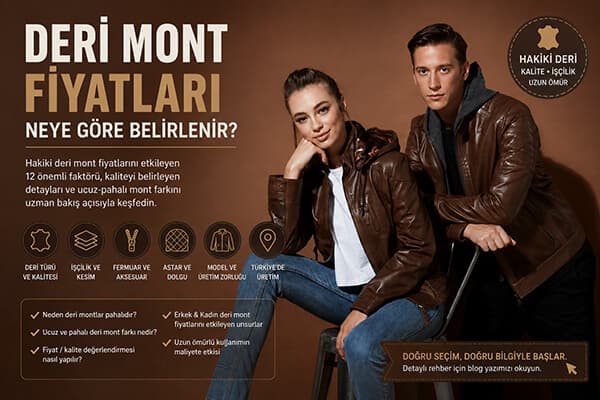
What Determines Leather Jacket Prices?
Quick Answer: Why Do Leather Jacket Prices Vary?
Leather jacket prices are not determined only by whether the product is made from genuine leather. Leather type and selection, thickness, tanning and finishing, the total amount of leather required, cutting waste, pattern and sewing workmanship, lining and insulation where used, zippers and hardware, design complexity and commercial factors related to the sales channel can all affect the final price. For this reason, two products both described as “genuine leather jackets” can have significantly different prices.
When comparing leather jacket prices, even products that look similar from the outside can have substantial price differences.
The reason is not simply the brand. Natural leather is not a completely uniform industrial sheet. Many variables, from the characteristics of the leather and garment length to cutting waste, lining and zipper systems, can influence production cost.
In addition, production cost and retail selling price are not the same thing. Sales channel, brand positioning, stock structure, promotions and other commercial costs can also influence the final price seen by the customer.
Therefore, when comparing genuine leather jacket prices, it is better to assess material, construction and intended use together rather than looking only at the price tag or the words “genuine leather”.
12 Key Factors That Can Affect Leather Jacket Prices
| Factor | How Can It Affect Price? | What Should the Customer Check? |
|---|---|---|
| 1. Leather Type | Different leather types can have different raw material, processing and usage characteristics. | Check which type of leather is used. |
| 2. Leather Selection and Characteristics | Raw hide structure, usable areas, surface characteristics and selectivity can affect cost. | Do not rely only on the words “genuine leather”. |
| 3. Tanning and Finishing | Dyeing, distressed effects, printing, suede, nubuck or other surface treatments may require different production stages. | Evaluate whether the finish suits the design and intended use. |
| 4. Amount of Leather Used | Longer, larger or more voluminous designs may require more leather. | Do not directly compare a short simple model with a longer or bulkier one. |
| 5. Cutting Waste | Not every part of a natural hide is suitable for every garment panel, so unused areas contribute to cost. | Look at panel consistency and overall surface balance. |
| 6. Pattern and Cutting | Correct placement of garment pieces on natural leather affects material use and production time. | Check panel transitions, proportions and overall garment form. |
| 7. Sewing and Workmanship | The precision and time required for leather sewing contribute to total production cost. | Check stitching, pockets, collar, sleeves and zipper joins. |
| 8. Lining and Insulation | Interior construction can increase material use, part count and production time. | Do not treat lining and insulation as the same feature. |
| 9. Zippers and Hardware | Zippers, snaps, buckles, hood attachments and other components can affect cost. | Look at function, application quality and reliability rather than quantity alone. |
| 10. Design Complexity | Multi-panel, quilted, insulated or detachable-detail models may require additional processes. | Do not compare simple and complex models only by price. |
| 11. Production Structure | Labour, quality control, production organisation and sourcing all contribute to cost. | Check how transparently the manufacturer explains its materials and production. |
| 12. Commercial Factors | Sales channel, brand positioning, promotions, inventory and other commercial costs can influence the final retail price. | Do not interpret list price alone as a measure of quality. |
1. How Does Leather Type Affect the Price?
One factor that can affect leather jacket pricing is the type of leather used. Lamb, sheep, goat and cowhide do not necessarily have the same fibre structure, thickness, weight or wearing characteristics.
Deriza primarily uses genuine lamb leather in its leather apparel collections. In leather garments, lamb leather can generally offer a relatively lightweight, soft and supple character.
However, leather type alone is not a quality or price grade. Two products being made from lamb leather does not mean they have the same properties or production cost.
For a detailed comparison of lamb leather and cowhide, see Lamb Leather vs Cowhide: Which Is Better?
2. Why Can Two Lamb Leather Jackets Have Different Prices?
Natural leather is not a completely standardised, homogeneous industrial sheet. Even within the same leather group, there can be differences in surface character, fibre structure, thickness and suitability for a particular application.
Raw hide selection, tanning, fatliquoring, dyeing, finishing and final sorting for the garment can all affect the characteristics and production cost of the finished leather.
Leather Engineer's Note
“Genuine leather” is not a detailed quality grade. Two products can both be made from genuine lamb leather while differing in leather selection, thickness, fibre structure, surface character, tanning and finishing.
Therefore, it is not technically accurate to assume that two jackets should have the same quality or price simply because the label lists the same leather type.
3. Do Tanning and Finishing Affect the Price?
Yes, they can. The colour, gloss, texture and surface effect visible on a leather jacket do not come only from the natural appearance of the raw hide.
Depending on the production objective, processes may include:
- matte or glossy surfaces,
- distressed effects,
- two-tone effects,
- printed surfaces,
- suede or nubuck characteristics,
- different dyeing and surface applications.
These may require different processing sequences.
However, a more complex or heavily processed finish does not automatically mean higher-quality leather.
What matters is whether the finish is appropriate for the leather structure, garment design and intended use.
4. Why Does the Amount of Leather Used Affect Price?
The cost of producing a leather jacket depends not only on the value of the leather itself, but also on the total amount of leather required for production.
Longer garments, larger sizes, wide collars, hoods, large pockets or more voluminous designs may require more leather.
For this reason, comparing a short and simple style directly with a longer, larger or more voluminous jacket based only on the product category can be misleading.
5. Why Is Cutting Waste Important?
Not every square centimetre of natural leather can necessarily be used for every part of a jacket.
The natural shape of the hide, surface variations, fibre structure and the position of each garment panel must be considered during cutting.
Unused areas become cutting waste. More selective panel placement can require more raw material to be introduced into production.
Therefore, the amount of leather visible on the finished jacket is not necessarily the same as the total amount of leather required to make it.
6. Why Is Cutting Leather Different From Cutting Textile Fabric?
Textile fabrics are generally supplied as relatively homogeneous lengths, whereas natural leather is processed as individual hides with their own shape and surface characteristics.
During cutting, manufacturers may need to consider:
- garment patterns,
- the direction and structure of the leather,
- surface character,
- visual balance between panels,
- natural variations,
- material efficiency.
Material placement is therefore an important stage in leather garment production.
7. How Does Workmanship Affect Leather Jacket Prices?
Cutting and sewing workmanship are important components of the total cost of leather garments.
Needle holes in leather can remain visible, so repeatedly unpicking and sewing the same area again is generally more limited than with many textile fabrics.
Processes such as:
- zipper installation,
- collar construction,
- pocket placement,
- sleeve setting,
- lining assembly,
- quilted details,
- multi-panel designs
can require additional production time and precision.
8. Do Lining and Insulation Affect Price?
Yes. However, lining and insulation are not the same thing.
The lining forms the interior surface of the garment and contributes to dressing comfort and internal construction. Insulation, where used, is a separate layer placed between the outer leather and lining to add thermal performance.
A lightweight leather jacket and an insulated or padded leather coat do not have the same material or production structure.
Cold-weather performance also does not depend on insulation alone; garment length, collar, closure system, lining, insulation and layering all contribute.
9. Why Do Zippers and Hardware Affect the Price?
In addition to the main zipper, a leather jacket may include pocket or sleeve zippers, snaps, buckles, belt systems, detachable hood attachments and other decorative or functional components.
Their type, quantity, application and installation can influence production cost.
However, more or heavier metal hardware does not automatically mean a higher-quality garment. Functionality, mechanical reliability and correct application are more important.
10. How Does Design Complexity Affect Price?
A simple leather jacket and a multi-panel biker, quilted, insulated, reversible or detachable-detail design do not require the same production process.
As complexity increases, the number of pattern pieces, cutting operations, assembly steps, hardware applications and sewing time can also increase.
However, a complex design does not automatically mean a higher-quality product. Design complexity is primarily one of the variables that can influence production cost.
11. How Does Production Structure Affect Price?
The country in which a product is manufactured is not a quality guarantee by itself. However, labour, production organisation, quality control, material sourcing and operational costs can all affect total cost.
Deriza leather apparel is manufactured in Türkiye. Leather selection, cutting, sewing, lining and hardware application are all parts of the production process.
For this reason, rather than looking only at “where was this made?”, it is more meaningful to consider how clearly the product's material and production characteristics are explained.
12. Do Sales Channels and Commercial Factors Affect Price?
Yes. The retail price seen by the customer is not made up of production cost alone.
Brand positioning, sales channel, store and operating costs, inventory structure, promotions and other commercial decisions can affect the final price.
This means two products with relatively similar production costs can still have different retail prices.
Likewise, the discount percentage on a product does not reveal its actual quality level on its own.
Why Can a Genuine Leather Jacket Be Expensive?
There is no single answer to the question why are genuine leather jackets expensive?
Price can be influenced by:
- natural leather raw material,
- leather selection,
- tanning and finishing,
- the total amount of leather used,
- cutting waste,
- pattern making and cutting,
- sewing workmanship,
- lining and insulation where used,
- zippers and hardware,
- design complexity,
- production and quality control,
- commercial costs.
However, a high price alone is not proof of high quality. Likewise, a low price alone does not prove that a product is low quality.
How Should You Compare Cheap and Expensive Leather Jackets?
| Check | Weak Comparison | Better Comparison |
|---|---|---|
| Leather | “Both are genuine leather.” | Compare leather type, selection, thickness and finishing. |
| Fit | “They look similar in the photos.” | Check actual garment measurements, shoulders, chest, waist and garment length. |
| Workmanship | “Both have stitching.” | Evaluate stitching consistency, panel joins, pockets and zipper installation. |
| Interior Construction | “Both have a lining.” | Evaluate lining, insulation where used and intended season separately. |
| Design | “Both are leather jackets.” | Consider length, number of panels, hood, quilting, pockets and other details. |
| Retail Price | “The more expensive one is better.” | Separate product characteristics from promotions and commercial pricing factors. |
Is a More Expensive Leather Jacket Always Better?
No.
A higher price does not automatically prove that the leather, fit or workmanship is better.
In addition to product characteristics, brand positioning, sales channels, promotions and other commercial variables can influence retail pricing.
A better question is:
“Which characteristics are behind this jacket's price, and are those characteristics suitable for my actual needs?”
How Should Usage Value Be Considered?
Usage value is not a direct production-cost component, but it is important when evaluating price versus value.
A garment that is used frequently and suits the owner's actual needs can have a different cost per wear from a cheaper product that is rarely used.
However, it is not accurate to claim that a genuine leather jacket will last a fixed number of years. Leather type and finishing, frequency of use, care, storage conditions and user habits can all influence its service life.
How Can You Evaluate Price and Quality?
When considering the price of a quality leather jacket, the following questions can be more useful:
- What type of leather is used?
- Is sufficient material information provided?
- Are the surface and finish suitable for the intended use?
- Are actual garment measurements and fit information available?
- Are stitching and panel joins consistent?
- Are the lining and insulation, if present, clearly explained?
- Are the zippers and other components functional?
- For which season and intended use is the garment designed?
- Are the production and material details transparent?
- Do these characteristics suit your actual needs?
Why Do Men's Leather Jacket Prices Vary?
Men's leather jacket prices can vary significantly according to garment design.
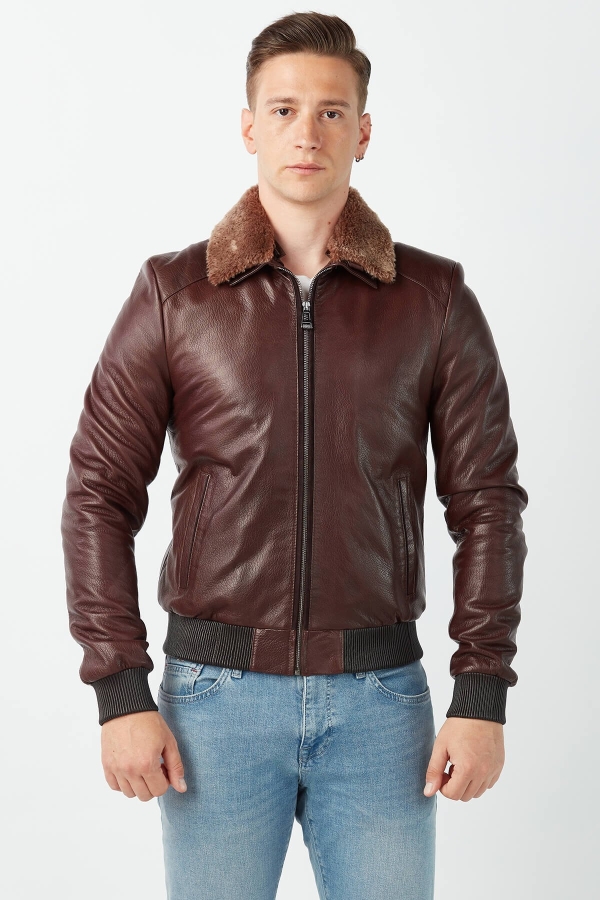
Classic, bomber, biker, pilot, hooded or insulated styles may use different amounts of leather, numbers of panels, hardware and interior construction.
For more detailed buying guidance, see What to Look for When Buying a Men's Leather Jacket .
To compare current styles, visit the Men's Leather Jackets collection.
Why Do Women's Leather Jacket Prices Vary?
Women's leather jacket prices can vary according to leather quantity, garment length, pattern, number of panels and design details.
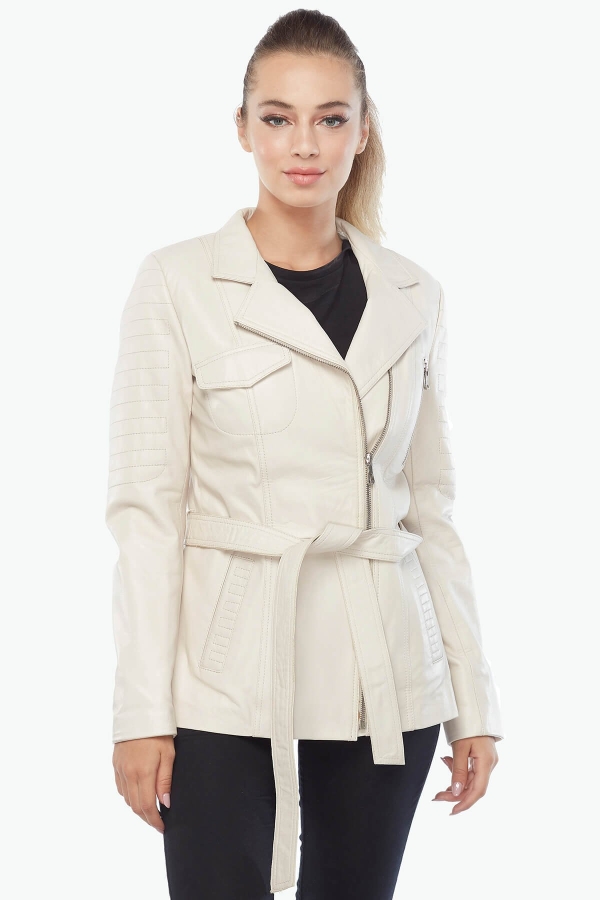
A short biker style, long leather jacket, oversized design, belted model, hooded or insulated jacket does not have the same construction.
For more information about fit and buying criteria, see What to Look for When Buying a Women's Leather Jacket .
To compare models, visit the Women's Leather Jackets collection.
5 Common Mistakes When Comparing Leather Jacket Prices Online
- Treating every product labelled “genuine leather” as equivalent: Genuine leather describes the material, not the complete level of leather selection, finishing or finished-product quality.
- Comparing only the lowest price: Differences in design, leather quantity, interior construction and production details may be missed.
- Treating every leather jacket and leather coat as the same type of product: A lightweight jacket and a longer or insulated garment may have very different material and construction requirements.
- Interpreting list price directly as quality: Promotions and other commercial factors can change the selling price.
- Comparing only photos without reading the technical details: Visually similar products can have different materials, internal construction and manufacturing characteristics.
Is Price or Quality More Important When Buying a Leather Jacket?
Rather than treating price and quality as opposites, it is more useful to evaluate price in relation to usage value.
The objective is not to buy the most expensive product, but to obtain material, fit, construction and workmanship that suit your actual needs for the price you pay.
For example, if you need a simple jacket for everyday wear, paying extra for complex details you will not use may not add meaningful value. If colder-weather use requires greater length, insulation or a different internal construction, choosing only the cheapest model may also be an incomplete comparison.
To compare different options, visit the Leather Jackets collection.
Frequently Asked Questions About Leather Jacket Prices
Why do genuine leather jacket prices vary so much?
Because “genuine leather” does not describe every characteristic of the product. Leather type and selection, thickness, tanning and finishing, leather quantity, cutting waste, workmanship, lining, insulation, hardware, design complexity and commercial factors can all influence price.
Why can genuine leather jackets be expensive?
Natural leather raw material, selection of usable areas, cutting waste, tanning and finishing, pattern making, sewing, lining, hardware and quality control can all contribute to total production cost.
Is an expensive leather jacket always higher quality?
Not always. A high price alone is not a quality indicator. Leather, finishing, fit, workmanship, interior construction and intended use should be evaluated together.
Is it worth buying an inexpensive genuine leather jacket?
A product should not be classified as good or bad only because of its low price. Check the material information, leather type, fit, stitching, lining, hardware, production details and how clearly the seller explains the product.
Why are lamb leather jackets sold at different prices?
Even within the same leather type, raw hide selection, fibre structure, thickness, finishing, total leather quantity, cutting waste and garment construction can vary. Therefore, two lamb leather jackets do not have to be priced at the same level.
Why can men's and women's leather jacket prices differ?
Gender itself does not directly determine the price. Leather quantity, garment length, pattern, number of pieces, lining or insulation, hardware and production complexity can differ between individual men's and women's designs.
Conclusion: Read the Price Through the Product, Not the Label Alone
When evaluating leather jacket prices, focusing only on the cheapest or most expensive option is not a reliable comparison method.
Production cost can be influenced by leather type and selection, tanning and finishing, total leather quantity, cutting waste, pattern making, cutting, sewing, lining, insulation, zippers, hardware and design complexity.
The final retail price can additionally be influenced by sales channel, brand positioning, promotions and other commercial variables.
Deriza primarily uses genuine lamb leather in its leather apparel collections, and its leather garments are manufactured in Türkiye. However, because each design can differ in leather quantity, fit, lining, insulation and construction details, every product should be evaluated according to its own characteristics.
The most useful question is therefore not “Is this jacket expensive?”, but “What material, construction, workmanship and usage characteristics am I getting for this price?”