




Genuine Leather Boots for Children and Babies
Quick Summary: The Deriza leather boots category currently consists only of children's and baby models. The collection includes boots made from genuine cowhide with hook-and-loop, lace-up and different closure structures. The right choice should be based not only on appearance but also on the child's current foot measurement, product fit, sole construction, ankle area, sock thickness and intended period of use.
The leather boots category brings together genuine leather boot models for children and babies that can be considered for cool and cold-weather periods. The current collection does not include adult boots.
The main question when choosing the right boots should not simply be “Which model looks better?” but “Which size, fit and closure structure is more suitable for the child's actual use?”
What Should You Consider When Choosing Leather Boots for Children and Babies?
- Foot measurement: The child's current foot length should be prioritized over age.
- Both feet: The right and left foot should be measured separately.
- Fit: Consider not only the shoe size but also the width of the foot and the fit of the model.
- Sole: It should be suitable for the intended environment without creating unnecessary stiffness.
- Ankle area: The boot should hold the foot in a balanced way without causing uncomfortable pressure.
- Closure system: Hook-and-loop or lace-up constructions should be evaluated according to ease of use and adjustability.
- Socks: Sock thickness affects internal space during winter use.
- Stage of use: Babies, children in the first-walking stage and more active children do not have exactly the same needs.
Why Does Deriza Use Genuine Cowhide in Children's and Baby Boots?
The primary material used in this product group is genuine cowhide.
Children's boots are exposed to bending, friction, outdoor contact and different ground conditions during everyday use. The ability to process cowhide with different thicknesses and finishes allows it to be adapted to different boot structures within this product group.
However, the phrase “genuine leather” alone does not define quality. Leather thickness, lining, fit, stitching, closure system and sole construction should be evaluated together.
Children's Boot Quality from a Leather Engineering Perspective
Deriza founder Recep Aycan is a graduate of Leather Engineering at Ege University. This technical background contributes to evaluating children's and baby boots not only according to appearance, but also according to the physical character, thickness, flexibility and surface treatment of the leather together with the way the product is used.
A boot is not a static product. The front section bends while walking, the ankle area moves, the sole contacts the ground, and the closure system is repeatedly used throughout the day.
For this reason, Deriza's approach to quality is not based only on “using genuine leather.” The compatibility of the leather with the product fit, sole, lining, closure system, stitching and overall product balance are evaluated together.
The aim is not to multiply technical terminology, but to turn leather knowledge into a product structure better suited to children's actual use.
Leather Boot Styles for Children and Babies
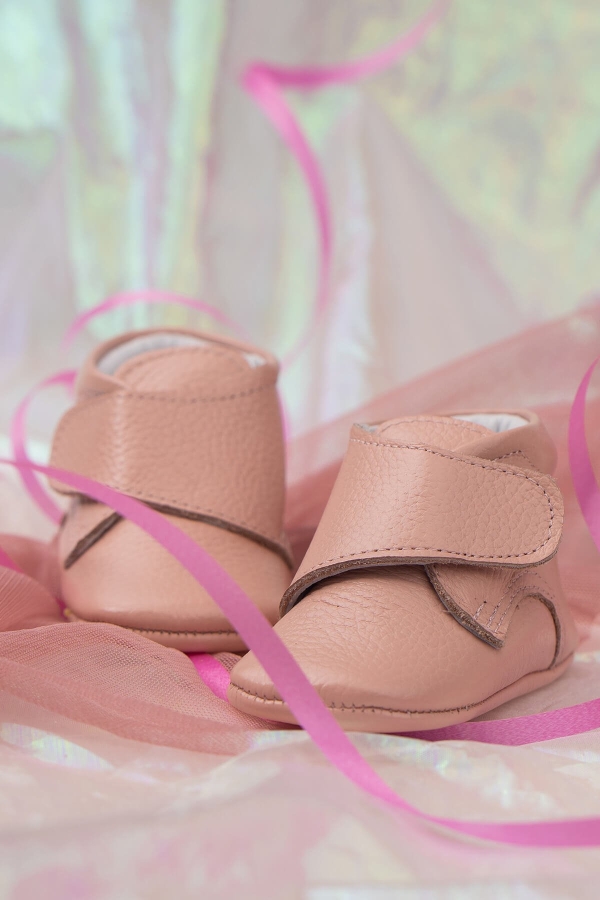
Leather Baby Boots
For younger age groups, low weight, ease of putting on and avoiding unnecessary pressure on the foot are important.
Children's Leather Boots
For more active everyday use, sole construction, closure system and the way the child uses the boots throughout the day may become more important.
You can also explore children's leather boots.
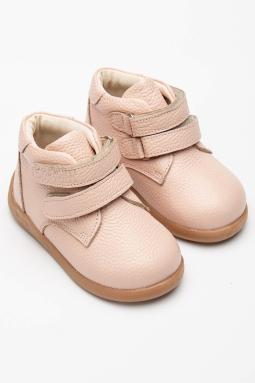
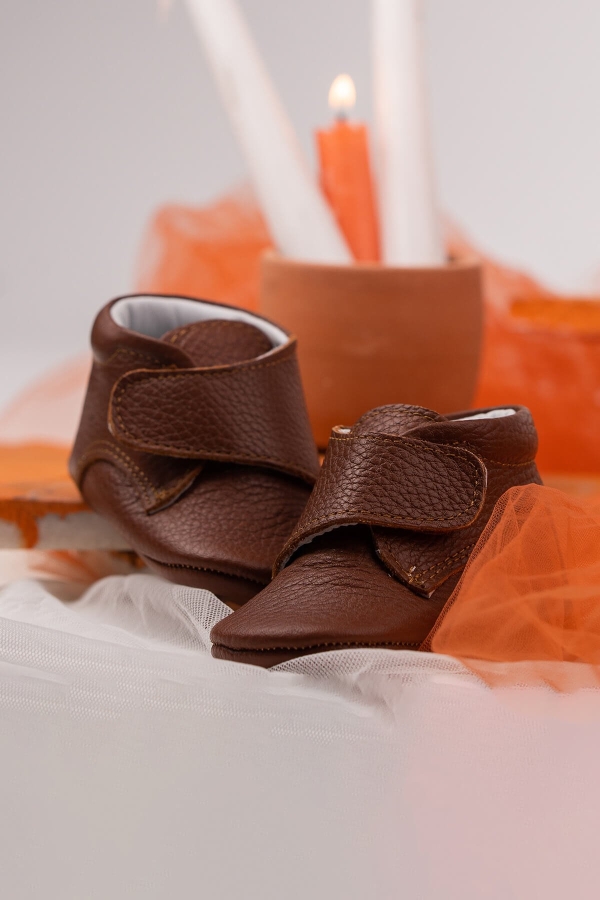
Hook-and-Loop Leather Boots
These can make putting on and taking off the boots quicker. They may provide practical advantages for younger children.
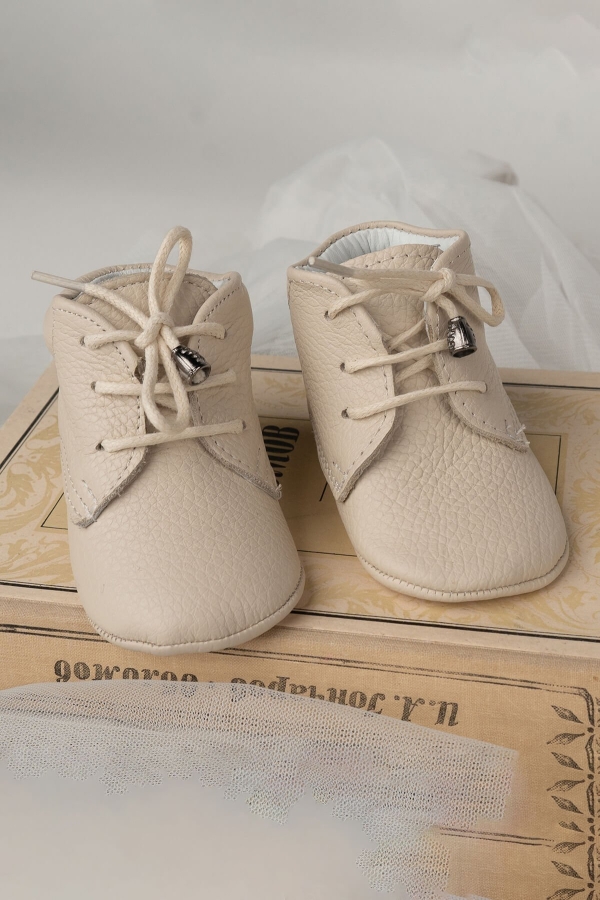
Lace-Up Leather Boots
These can allow the closure tension to be adjusted more precisely across different areas of the foot.
Hook-and-Loop or Lace-Up Children's Boots?
There is no single correct answer.
Hook-and-loop models can provide quicker putting on and removal.
Lace-up models can help provide more controlled adjustment across different areas of the foot.
The choice should be based on the child's age, everyday usage habits and the parent's need for practicality.
How Should Children's and Baby Boot Size Be Chosen?
Boot size should not be selected according to age alone.
- Measure both of the child's feet on a flat surface.
- Measure the distance from the heel to the longest toe.
- Use the longer foot as the reference.
- Compare the measurement with the size chart of the specific product.
- If the boots will be used in winter, also take sock thickness into account.
The approach “Let's buy several sizes larger so they can wear them longer” is not appropriate.
Boots that are too large can allow excessive movement of the foot inside the product, while boots that are too small can restrict toe space.
Should There Be Extra Toe Space Inside the Boot?
Yes, but there should not be excessive empty space.
The toes should not be compressed, but the boot should also not move uncontrollably back and forth on the foot.
The correct amount of space should be determined by considering the product fit together with the child's actual foot measurement.
Does a Winter Sock Affect Boot Size?
Yes.
A thick sock can reduce the usable internal space of the boot. For this reason, if the boots will be worn with winter socks, size and fit should be evaluated under actual usage conditions.
However, it is not appropriate to automatically choose one or two sizes larger only because a thick sock will be worn.
Why Is Sole Construction Important in Baby Boots?
In baby and young children's boots, the sole directly affects how the product is used.
An unnecessarily stiff construction can restrict movement, while sufficient sole durability is also required depending on the environment of use.
For this reason, the right approach is not to generalize with statements such as “the softer the better” or “the thicker the better,” but to evaluate the actual intended use of the model.
Can Leather Boots Be Used During the First-Step Stage?
Whether a boot is suitable for the first-walking stage should not be determined only because it is called a “baby boot.”
The model's:
- sole construction,
- weight,
- fit,
- closure system,
- ankle-area construction
should be evaluated together.
For models specifically intended for this stage, you can consider genuine leather first-step shoes.
How Should the Ankle Area of Children's Boots Fit?
The boot may surround the ankle, but this area should not be excessively tight.
Once fastened, the ankle area should not create uncomfortable pressure, marks or restriction of movement.
At the same time, an excessively loose fit around the ankle may cause uncontrolled movement of the boot on the foot.
How Can You Tell If Children's Boots Are Too Small or Too Large?
Signs That May Suggest the Boots Are Too Small
- Toes being compressed at the front
- The closure system being excessively strained
- Noticeable pressure over the top of the foot
- Unnecessary difficulty when putting the boots on
Signs That May Suggest the Boots Are Too Large
- Excessive heel movement inside the boot
- The boot nearly slipping off while walking
- Noticeable movement of the child's foot inside the product
In these cases, the product size and fit should be reassessed.
Can Children's and Baby Leather Boots Be Used in Winter?
Because boots are closed footwear structures, they can be considered for cool and cold-weather periods.
However, the actual cold-weather performance of a boot is not determined by the outer leather alone.
The lining, sole, product height, socks, closure system and weather conditions all play a role.
For this reason, the same warmth performance should not be attributed to every leather boot.
Can Genuine Leather Boots Be Worn in the Rain?
Genuine leather is not a completely waterproof technical footwear material.
It may be exposed to light moisture, but prolonged and heavy rain or water contact should be avoided whenever possible.
Wet boots should be allowed to dry naturally at room temperature. Radiators, stoves or hair dryers should not be used.
Does Genuine Leather Breathe?
Genuine leather is a natural material, but the total breathability of the product does not depend only on the outer leather.
The lining, finish, padding, socks and overall product construction also affect the internal wearing experience.
For this reason, the statement “genuine leather = completely breathable in every condition” is not accurate.
Are Texture and Tone Variations Normal in Genuine Leather?
Genuine cowhide is a natural material.
Slight grain, pore, surface texture and tone variations may be part of the natural character of leather.
Natural surface variations should be distinguished from actual scratches, cuts or manufacturing damage.
How to Care for Children's and Baby Leather Boots
- Do not wash genuine leather boots in a washing machine.
- Gently clean mud and surface dirt in a way suitable for the product.
- Do not apply cologne, alcohol or strong chemicals directly to the leather surface.
- Do not dry wet boots using high heat.
- After use, allow the inside to air naturally.
- Test any care product first on a small, inconspicuous area.
How Should Children's Leather Boots Be Stored?
- Store the boots clean and completely dry.
- Do not leave them in direct sunlight.
- Do not keep them in damp environments for long periods.
- Do not place heavy objects on top in a way that may deform their shape.
- Do not leave them for long periods in airtight plastic packaging.
What Determines Genuine Leather Boot Prices for Children and Babies?
Leather boot prices are not determined only by whether the product is made from genuine leather.
Factors that may affect price include:
- the quality and amount of genuine cowhide,
- upper height,
- lining construction,
- sole type,
- closure system,
- number of components and stitches,
- manufacturing workmanship.
For this reason, comparing two boots only by saying “both are genuine leather” is incomplete. Material, size compatibility, sole, fit, closure system and workmanship should be evaluated together.
Checklist for Buying Leather Boots
- Measure the child's current foot length.
- Measure both feet separately.
- Do not choose size according to age alone.
- Take winter sock use into account.
- Check the product fit.
- Evaluate the toe area.
- Make sure the ankle area is not excessively tight.
- Determine whether a hook-and-loop or lace-up closure is more suitable.
- Do not evaluate the sole only according to its thickness.
- Check first-step suitability on a model-specific basis.
- Do not buy several sizes larger based on the idea that “they will grow into it.”
- Do not choose a smaller size based on the idea that “the leather will stretch.”
Why Choose Deriza Genuine Leather Boots for Children and Babies?
- Genuine cowhide: Natural leather material used in children's and baby footwear.
- Leather engineering background: An approach that evaluates leather thickness, flexibility and surface characteristics together with product fit and intended use.
- Measurement-focused selection: Prioritizing the child's current foot measurement rather than age.
- Model-specific evaluation: Distinguishing between baby, children's, hook-and-loop and lace-up boots rather than treating them as identical products.
- Construction-focused quality: Evaluating quality not only through the outer leather but also through the sole, lining, stitching and closure system.
- Production in Türkiye: A structure that brings Beybium children's footwear together with Deriza's leather and manufacturing experience.
Related Children's and Baby Footwear Collections
For boot models specifically for children, you can consider children's leather boots.
For baby footwear options, explore baby shoes; for models intended for the first-step stage, consider genuine leather first-step shoes.
For all footwear groups, explore leather shoes; for the complete baby and children's collection, consider the main kids & baby category.
For customizable baby footwear, you can consider personalized baby shoes.
Frequently Asked Questions About Leather Boots
Are there adult models in the Leather Boots category?
No. The category currently consists only of children's and baby boot models.
What type of leather is used in children's and baby boots?
Genuine cowhide is used in this product group.
Should children's boots be bought several sizes larger?
No. Boots that are too large may allow excessive movement of the foot inside the product.
Can boot size be chosen only according to age?
No. The child's current foot length provides a more reliable reference.
Does a winter sock affect boot size?
Yes. A thick sock can affect the internal space and should be considered during selection.
Which is more practical: hook-and-loop or lace-up children's boots?
Hook-and-loop models can provide greater practicality, while lace-up models can allow more controlled adjustment. The choice should be based on usage habits.
Should the sole of a baby boot be stiff?
An unnecessarily stiff sole should not be preferred. Sole construction should be evaluated according to the intended environment and the specific model.
Can baby boots be used during the first-step stage?
This should be evaluated according to the model's sole, fit, weight and closure characteristics.
Should the ankle area of children's boots be tight?
The boot should hold the ankle in a balanced way without creating uncomfortable pressure.
Can genuine leather boots be worn in the rain?
They should be protected from heavy and prolonged water exposure. Wet products should be allowed to dry naturally without high heat.
Can leather boots be machine washed?
No. Genuine leather boots should not be washed in a washing machine.
Why do leather boot prices vary?
The quality and amount of cowhide, upper height, sole, lining, closure system and manufacturing workmanship may affect the price.