


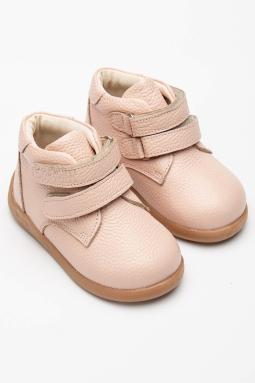


Children's Genuine Leather Boots: Models and Prices
Quick Summary: The Deriza children's leather boots collection brings together genuine cowhide leather boots with hook-and-loop closures, zips, laces and, depending on the model, lining. The right choice should consider not only shoe size but also the child's current foot length, foot width, socks to be worn, toe room, sole construction, product weight, ankle height, closure system and intended environment.
Children's leather boots are genuine leather children's footwear that can be considered especially for autumn and winter, school, nursery, everyday city use and suitable outdoor conditions.
The right children's boot is not simply the model that fits onto the foot or looks the thickest. It is the model that fits the child's actual foot measurements, has a sole and internal structure suitable for the intended environment and does not unnecessarily restrict everyday movement.
What Should You Consider When Choosing Children's Leather Boots?
- Actual foot measurement: The child's current foot length should be used rather than age alone.
- Measure both feet: Measure the right and left foot separately and use the longer foot as reference.
- Foot width: Two children with the same foot length may have different forefoot widths.
- Sock thickness: If the boots will be worn with winter socks, sizing should be evaluated accordingly.
- Toe room: The toes should not be compressed, but there should not be excessive empty space either.
- Closure system: Hook-and-loop, zip or laces should provide both ease of use and appropriate fit.
- Sole: Choose a structure suitable for the intended ground surface without unnecessary weight or excessive stiffness.
- Lining: Evaluate it together with the expected temperature and time spent indoors.
- Product weight: A heavier boot is not automatically better quality or warmer.
- Water exposure: Unless specifically stated for the product, genuine leather boots should not be treated as technical waterproof boots.
Genuine Cowhide Leather in Children's Boots
Deriza children's boot models primarily use genuine cowhide leather.
During everyday use, the upper of a children's boot is exposed to:
- bending,
- friction,
- tension around closure points,
- outdoor conditions.
For this reason, the "genuine leather" label alone is not sufficient. The leather should be used at an appropriate thickness and flexibility and evaluated together with the last, stitching, lining, sole attachment and closure system.
A Leather Engineering Approach to Children's Boots
Deriza founder Recep Aycan is a graduate of Ege University Leather Engineering. This technical background contributes to evaluating children's boots not only by appearance or leather type but as a footwear construction in which leather thickness, flexibility, last, lining, sole and usage loads work together.
Using thicker leather does not automatically produce a better children's boot. An unnecessarily stiff or heavy upper may make everyday movement more difficult.
Likewise, using only very soft material is not by itself an indicator of quality.
The correct approach is to balance: leather + last + sole + lining + closure system + actual foot measurement + intended environment.
How Should Children's Boot Size Be Chosen?
- Measure both of the child's feet, preferably while the child is standing.
- Measure the distance from the rearmost point of the heel to the longest toe.
- If the feet differ, use the longer foot as reference.
- If the boots will be worn with winter socks, use socks of a similar thickness during measurement.
- Compare the foot measurement with the product's size or internal-length information.
- Use age only as an approximate reference.
The most reliable starting point is the child's actual measurement in centimeters.
Should Children's Boots Be Bought One Size Larger?
Not automatically.
Buying an unnecessarily large boot because "it will also fit next winter" may cause:
- the heel to lift inside the boot,
- the foot to move forward and backward,
- the child to drag the boot,
- unnecessary internal volume while walking.
Some growth allowance may be considered, but the amount should be evaluated together with the actual internal dimensions and fit of the specific model.
Do Winter Socks Affect Boot Size?
Yes.
Thick socks increase not only the length-related fit but also the overall volume occupied by the foot inside the boot.
For this reason, choosing winter boots based on measurements taken with very thin socks or bare feet may be misleading if the boots will usually be worn with thick socks.
However, buying an unnecessarily oversized boot just to accommodate thicker socks is also not correct.
Why Is Foot Width Important?
Foot length alone is not enough when choosing children's boots.
Wide Feet
Avoid unnecessarily narrow or pointed toe shapes.
High Instep
Adjustable closure systems such as hook-and-loop or laces may be more practical.
Narrow Feet
Check that the foot does not move excessively forward and backward inside the boot.
The same shoe size does not fit every child in the same way.
How Should the Toe Area of Children's Boots Fit?
The front of the boot should not unnecessarily compress the toes.
The toes should remain in a natural position without overlapping.
However, excessive length or width in the toe area may also allow uncontrolled movement of the foot inside the boot.
The aim is to create controlled internal space rather than a tight fit.
How Can You Tell Whether Children's Boots Fit Properly?
- The heel should not continuously lift while walking.
- The toes should not be compressed in the front.
- There should be no obvious pressure on the instep.
- The upper edge should not continuously rub against the ankle.
- The closure system should hold the boot in place without unnecessary pressure.
- The child should not clearly drag the boot while walking.
- Repeated attempts to remove the boot or signs of discomfort should not be ignored.
How Can You Tell If Children's Boots Are Too Small?
- Pressure marks on the toes or instep.
- The boot becomes more difficult to put on than before.
- The closure becomes difficult to fasten.
- Toe space noticeably decreases.
- The child does not want to wear the product or shows discomfort.
Because children's feet can grow, the fit should be checked again throughout the season.
Hook-and-Loop, Zip or Lace-Up Children's Boots?
Hook-and-Loop Children's Boots
Can be opened and closed quickly and may be practical especially for children beginning to put on their own boots.
Zip Children's Boots
Can offer the advantage of quick everyday putting on and removal.
Lace-Up Children's Boots
May help provide more controlled adjustment over the instep.
Zip + Laces
The laces can be used for adjustment while the zip makes everyday putting on and removal easier.
No single system is better for every child. The child's age, foot structure and ability to use the footwear independently should be considered together.
Is It Important for a Child to Put On Their Boots Independently?
Especially at school and nursery age, yes.
Being able to put on and remove the boots without help can provide considerable convenience in everyday use.
However, a poorly fitting model should not be chosen simply because it opens and closes easily.
What Should the Sole of Children's Boots Be Like?
The sole should be evaluated according to the intended environment.
For everyday children's boots, it is important that the sole:
- does not create unnecessary weight,
- does not make walking excessively stiff,
- provides a contact surface suitable for the ground,
- works in balance with the upper.
For winter outdoor use, sole pattern and surface conditions may become more important.
However, no sole completely eliminates the risk of slipping on ice, wet tiles, mud or similar slippery surfaces.
Is a Thicker or More Aggressively Treaded Sole Safer?
Not automatically.
The appearance of the sole alone does not explain its performance on the ground.
Grip behavior is affected by:
- sole material,
- tread pattern,
- surface type,
- wetness,
- ice or mud.
Therefore, absolute claims such as "a treaded sole never slips" are not accurate.
Is a Heavy Children's Boot a Problem?
Unnecessary weight in a children's boot worn throughout the day may reduce wearing comfort.
However, choosing only the lightest boot is not necessarily correct either.
Product weight should be evaluated together with:
- sole,
- lining,
- ankle height,
- amount of leather,
- closure system.
A heavier boot is not automatically better quality or warmer.
Why Is Ankle Height Important in Children's Boots?
The upper section surrounding the ankle creates a different wearing character from a low shoe.
Greater ankle height may provide more coverage for outdoor and cold-weather use.
However, the upper section should:
- not unnecessarily squeeze the ankle,
- not create rubbing while walking,
- not excessively restrict movement.
Ankle height alone does not mean medical or orthopedic support.
When Should Lined Children's Boots Be Preferred?
Lined models or boots with warmer internal structures may be considered for cold-weather use.
However, not all linings are the same and the word "lined" alone does not guarantee a specific warmth performance.
Also consider whether the boot will be used:
- outdoors,
- in warm indoor environments such as school or nursery,
- for short periods,
- for long periods.
Do Genuine Leather Children's Boots Cause Sweating?
Moisture around the foot does not depend only on the outer material of the boot.
Moisture can be affected by:
- the child's activity level,
- sock type,
- lining,
- ambient temperature,
- duration of use.
Therefore, absolute statements such as "genuine leather never causes sweating" or "does not cause odor" should not be used.
Are Children's Leather Boots Waterproof?
Genuine leather alone does not mean technical waterproofing.
Unless a boot is made with a dedicated waterproof membrane or system, it should not be assumed to be fully waterproof in heavy rain simply because it is made from genuine leather.
If the product description does not explicitly state "waterproof", the boot should not be treated as a technical rain or snow boot.
Can Children's Leather Boots Be Worn in Snow?
Depending on the lining, sole and leather structure of the model, they may be considered for light snow and cold urban conditions.
However, for:
- heavy snow,
- prolonged wet ground,
- puddles,
- icy surfaces,
you should check whether the specific product actually has technical features intended for these conditions.
How Should Children's Boots Be Chosen for School and Nursery?
For school and nursery use, the following are particularly important:
- easy putting on and removal,
- correct size,
- avoiding unnecessary weight,
- the child's ability to close the boot independently,
- suitability for long periods in warm indoor environments.
A thick winter boot worn all day in a warm classroom may not be ideal for every child.
How Should Children's Boots Be Chosen for Parks and Everyday Outdoor Use?
For more active outdoor use, the following become more important:
- sole construction,
- product weight,
- proper fit,
- stability of the closure system,
- the type of ground where the boot will be used.
Are First-Step Boots and Children's Boots the Same?
No.
The footwear needs of a baby who has just started walking are not the same as the everyday boot needs of an older child who walks more steadily.
For footwear intended for the first-step stage, explore the genuine leather first-step shoes collection.
What Should Be the Main Criterion When Choosing Boots for Girls and Boys?
Color and design are personal preferences.
The main criteria should be:
- correct size,
- foot structure,
- closure system,
- sole,
- lining,
- intended environment.
A design the child enjoys wearing is important, but appearance should not take priority over functional suitability.
How Should Genuine Leather Children's Boots Be Cleaned?
- Do not wash them in a washing machine.
- Allow heavy mud to dry on the surface first.
- Clean gently with a soft, slightly damp cloth.
- Do not immerse the boots completely in water.
- Do not apply alcohol, cologne or strong cleaners directly to the leather.
- Air the inside after use.
- Do not dry wet boots using a radiator, stove or hair dryer.
How Should Wet Children's Leather Boots Be Dried?
Remove excess surface moisture with a soft cloth.
Suitable paper may be placed inside the boots to help preserve their shape, and the product may be left to dry naturally at room temperature.
The boots should not be used again before they are fully dry and should be kept away from high-heat sources.
What Determines Children's Leather Boot Prices?
Children's leather boot prices are not determined solely by the fact that the product is made from genuine leather.
Factors that may affect price include:
- the quality and amount of genuine cowhide leather,
- product height,
- number of leather pieces,
- lining and internal construction,
- sole system,
- hook-and-loop, zip or lace structure,
- stitching and manufacturing workmanship.
Therefore, comparing two boots solely by saying "both are genuine leather" is incomplete.
Children's Leather Boot Buying Checklist
- Measure both of the child's feet.
- Use the longer foot as reference.
- Take winter sock thickness into account.
- Evaluate foot width and instep shape.
- Check the toe area.
- Make sure the heel does not move excessively inside the boot.
- Choose hook-and-loop, zip or laces according to the child's age and ability to use them.
- Evaluate whether the sole is suitable for the intended ground surface.
- Consider the product's weight.
- Do not assume the boot is waterproof simply because it is made from genuine leather.
- Do not buy an excessively large size in the hope that it will fit for several seasons.
- Recheck throughout the season whether the boot still fits the child's foot correctly.
Why Choose Deriza Genuine Leather Children's Boots?
- Genuine cowhide leather: Natural leather material used in the upper of children's boots.
- Leather engineering background: A technical approach that evaluates leather thickness, flexibility and boot construction together.
- Actual-measurement-based selection: Prioritizing the child's current foot length and foot structure rather than age alone.
- Different closure systems: Hook-and-loop, zip and lace-up options.
- Evaluation according to intended environment: Not applying the same criteria to school, city and suitable outdoor use.
- Transparent product language: Not automatically describing genuine leather as waterproof, sweat-free or orthopedic.
- Made in Türkiye: Deriza and Beybium's experience in leather and children's footwear production.
Related Children's and Baby Footwear Collections
For a broader range of boot models, explore the leather boots category.
For babies who are beginning to walk, explore the genuine leather first-step shoes collection.
For softer baby styles, explore leather baby booties & moccasins and baby shoes.
For warm-weather options, explore children's leather sandals and children's leather slippers.
For all children's and baby products, explore the main Children & Baby category.
Frequently Asked Questions About Children's Leather Boots
What type of leather is used in Deriza children's boots?
Deriza children's leather boot models use genuine cowhide leather.
How should children's boot size be selected?
Both feet should be measured and the longer foot should be compared with the product's size or internal-length information.
Should children's boots be bought one size larger?
Not automatically. Actual foot measurement, sock thickness and the fit of the specific model should be evaluated together.
Do thick socks affect boot size?
Yes. Thick socks increase the volume occupied by the foot inside the boot and should be considered when selecting size.
Which is better: hook-and-loop, zip or laces?
No single system is best for everyone. The child's age, foot structure and need to put on and remove the boots independently should be considered together.
Should the sole of children's boots be stiff?
The sole should provide suitable performance for the intended ground surface without being unnecessarily stiff or heavy.
Are genuine leather children's boots waterproof?
Genuine leather alone does not mean complete waterproofing. Technical waterproofing should be stated for the individual product.
Can children's leather boots be worn in snow?
Depending on the model's sole and lining, they may be suitable for light winter conditions; for heavy snow and prolonged wet ground, the technical features of the specific product should be checked.
Are lined children's boots warmer?
Lining may contribute to cold-weather use, but actual warmth depends on the lining type, socks, outside temperature and duration of use.
Are first-step boots and children's boots the same?
No. The footwear needs of babies who are beginning to walk should be evaluated differently from the everyday boot needs of older children.
How should children's leather boots be cleaned?
Clean the surface with a soft, slightly damp cloth; do not wash the boots in a washing machine or dry them using high heat.
Why do children's leather boot prices vary?
The quality and amount of cowhide leather, lining, sole system, product height, closure system and manufacturing workmanship may affect the price.