
What Should You Consider When Choosing First Walking Shoes?
Quick answer: When choosing first walking shoes, do not rely only on the labelled size or appearance. The baby's actual foot length, the product's own size chart, fit, toe room, sole construction, upper material and how securely the shoe fits the foot should all be considered together.
If a baby is not yet walking independently, constant shoe use, especially indoors, is not always necessary. First walking shoes are better considered as properly fitted footwear that helps protect the feet when walking outdoors.

A baby's first steps are also the stage when footwear selection starts to require more attention. However, there is no single ideal model or one technical specification list that applies to every baby.
Because each baby's foot shape, walking stage and shoe fit can differ, the right choice should be based on actual measurements and the construction of the specific product.
When Does a Baby Need First Walking Shoes?
Babies begin walking at different times. For this reason, it is not appropriate to define one fixed age at which first walking shoes must be purchased.
If a baby is still crawling, pulling to stand or moving while holding onto furniture, continuous shoe use may not be necessary, especially in a safe indoor environment.
Once independent walking has started, particularly outdoors, properly fitted footwear may be considered to help protect the feet from the ground and environmental conditions.
The Most Important Criteria When Choosing First Walking Shoes
| Criterion | What to Check | Why It Matters |
|---|---|---|
| Foot Measurement | Actual foot length | Helps avoid choosing only by age or estimated shoe size |
| Size Chart | Measurements specific to the product | Recognises that the same labelled size may differ between models |
| Toe Room | No unnecessary pressure around the toes | Helps prevent the toes from being compressed inside the shoe |
| Fit | Narrow, regular or wide construction | Affects compatibility with the baby's foot shape |
| Sole | Flexibility, grip and overall construction | Influences how the shoe behaves during walking |
| Fastening | Hook-and-loop, laces, elastic or other systems | Affects how securely and appropriately the shoe fits |
1. How Should You Measure a Baby's Foot Length?
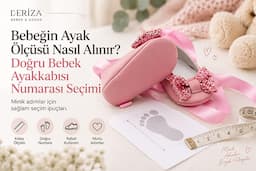
One of the most reliable starting points when choosing first walking shoes is measuring the baby's actual foot length.
Where possible, measure both feet, because the two feet do not always have exactly the same dimensions.
After measuring, compare the result with the specific size chart provided for the shoe model.
Do not choose size only from assumptions such as “the baby wore size 18 last month” or “babies of this age usually wear size 19.”
2. How Much Growing Room Should First Walking Shoes Have?
There is no single fixed growing allowance that should be applied to every baby shoe.
Suitable space can vary according to the last, toe construction, internal measurements and the manufacturer's sizing system.
Some health guidance refers to approximately 1 cm of space in front of the toes, but rather than treating this as an unchanging rule for every model, it is safer to use the specific product's measurements and size chart.
Shoes that are too small are unsuitable, but shoes that are unnecessarily large can also create problems. Buying shoes several sizes too large simply so that they can be worn for longer is not recommended.
3. What Should the Toe Area Be Like?
The front of the shoe should not unnecessarily compress the baby's toes.
The toe area should provide an appropriate amount of space for the individual foot and should not restrict the toes unnecessarily.
However, the phrase “wide toe box” alone does not guarantee the correct fit. The actual internal dimensions of the product should be considered together with the baby's foot shape.
4. Should the Sole Be Very Stiff or Very Soft?

The sole of a first walking shoe should not be so rigid that it unnecessarily restricts foot movement.
At the same time, it is not correct to assume that “the softer and more bendable the sole, the better.”
The sole should have appropriate flexibility for the intended use, sufficient structural integrity and suitable grip for the surface on which the shoe will be used.
Rubber, thermoplastic and other sole systems may be used. The name of the sole material alone does not mean that the shoe is automatically better or healthier.
5. What Are the Advantages of Genuine Leather in First Walking Shoes?
Genuine leather is a natural material that can be used in footwear production. Depending on leather type, thickness and finish, it can have different softness and wearing characteristics.
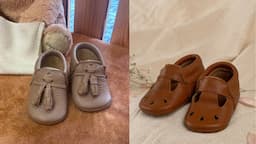
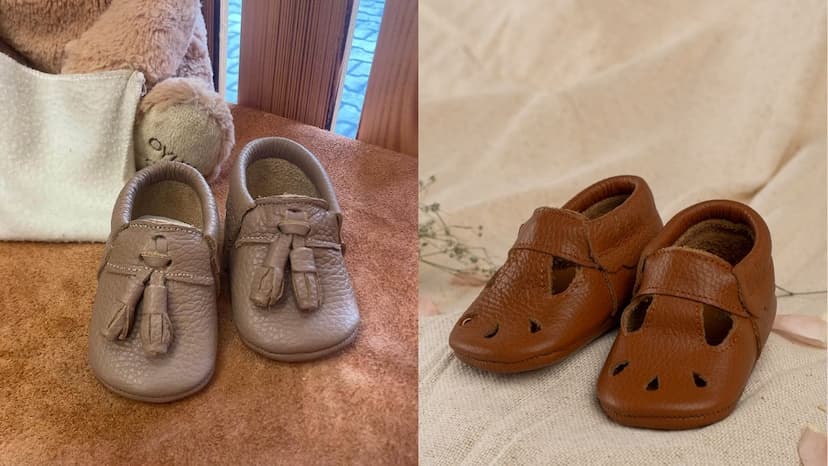
Depending on the model, Deriza first walking shoes may use genuine bovine leather and genuine leather lining.
However, the phrase “genuine leather” alone does not automatically mean that a shoe is healthier, more durable or suitable for every baby.
Fit, stitching, lining, sole construction, fastening system and actual size compatibility should also be evaluated.
Leather Engineer's Note: Understanding the Phrase “Breathable Leather”
Natural leather can show properties such as moisture exchange and water-vapour permeability. However, these properties vary depending on leather type, thickness, tanning and finishing.
For this reason, statements such as “feet never sweat because the shoe is leather” or “synthetic materials never breathe” are not accurate as universal rules.
The internal climate of a shoe is influenced by the upper material, lining, thickness, adhesive systems, sole construction and conditions of use.
6. Why Is It Important for the Shoe to Fit Securely?
First walking shoes should not fit excessively loosely or excessively tightly.
Hook-and-loop straps, laces, elastic and other fastening systems can help the shoe sit appropriately on the foot.
The goal is not to rigidly “lock” the foot in place, but to achieve a secure fit that helps prevent the shoe from slipping off or the foot from sliding excessively forward inside it.
7. What Should the Heel Area Be Like?
The heel area should not unnecessarily compress the foot and should not allow the heel to repeatedly slip out during use.
However, there is no universal rule that “the firmer the heel, the better.”
Heel construction should be considered together with the overall fit and fastening system of the shoe.
8. Should First Walking Shoes Have a Flat Sole?
Statements such as “first walking shoes must always be completely flat” or “they must always have special arch support” should not be generalised to every child.
For an average child, special support designed to shape the foot is not routinely required simply because the child is learning to walk.
The sole and internal construction should be evaluated according to the actual product specifications.
9. Do First Walking Shoes Need to Be Orthopaedic?
The word “orthopaedic” does not automatically mean that a shoe is better.
It cannot be said that every healthy child requires special orthopaedic support in first walking shoes.
If there is concern about the child's feet, walking pattern or development, decisions should be based on assessment by a paediatrician or an appropriate healthcare professional rather than general product descriptions.
10. Should First Walking Shoes Be Worn Indoors?
In a safe indoor environment, a baby who is learning to walk may not need to wear shoes continuously.
Moving barefoot, or in conditions that do not unnecessarily restrict the feet, can allow the baby to feel the floor directly.
Footwear is generally more relevant outdoors, where it can help protect the feet from the ground, temperature and physical environmental contact.
11. How Often Should You Check the Shoe Size?
The feet of babies and young children can change relatively quickly. For this reason, it is not appropriate to assume that one pair will remain suitable for a long period.
The fit should be checked regularly.
Toes approaching the front too closely, pressure at the sides, significant heel movement or unusual difficulty when putting the shoes on may indicate that the size should be reassessed.
12. Should First Walking Shoe Size Be Chosen Only by Age?
No.
Age can provide only a very general reference. Two babies of the same age may have different foot lengths and widths.
Actual foot measurements and the specific product's size chart should therefore take priority.
Choosing the Right Size for Deriza First Walking Shoes
Deriza first walking shoe models may be available in sizes 17–21.
However, size should not be selected from the number alone. The actual product measurements should be compared with the baby's foot length.
The same labelled size may not mean exactly the same internal length in a different model or another brand.
First Walking Shoe Buying Checklist
Frequently Asked Questions About First Walking Shoes
When should first walking shoes be purchased?
If a baby is not yet walking independently, continuous shoe use may not be necessary, especially indoors. Once independent outdoor walking begins, properly fitted footwear can be considered to help protect the feet from environmental conditions.
What size should first walking shoes be?
Instead of selecting a fixed size according to age, measure the baby's actual foot length and compare it with the size chart for the specific product.
Should first walking shoes be bought one size larger?
Automatically choosing one or several sizes larger is not recommended. Suitable extra room should be evaluated according to the last and actual internal measurements of the specific shoe.
How much growing room should first walking shoes have?
There is no single fixed value that applies to every model. The shoe last, toe construction and product size chart should be used as the main references.
Are genuine leather first walking shoes better?
Genuine leather is a natural material that can offer different wearing characteristics. However, the suitability of a shoe does not depend only on whether it is made from leather. Fit, size, sole, lining, fastening and overall construction should be considered together.
Do first walking shoes need to be orthopaedic?
Special orthopaedic support is not automatically required for every healthy child. If there is an individual foot or walking concern, an appropriate healthcare professional should provide the relevant assessment.
Conclusion: Proper Fit Is the Most Important Part of Choosing First Walking Shoes
When choosing first walking shoes, actual fit and product construction are just as important as brand, colour and appearance.
The baby's foot length, actual product measurements, fit, toe room, sole, upper material and fastening system should all be considered together.
The right first walking shoe is one that does not unnecessarily compress the foot, is not excessively large and has a construction suited to the intended environment.
Explore First Walking Shoe Options
After measuring your baby's actual foot length, compare first walking shoe models according to product measurements, size, fit and material characteristics.