

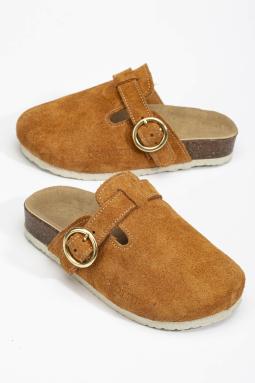

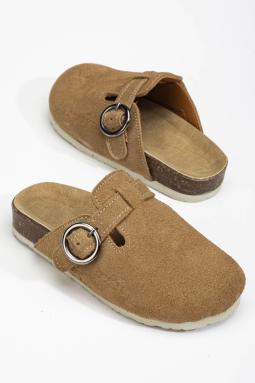
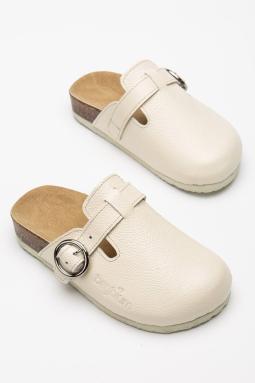
Children's Genuine Leather Slippers
Quick Summary: The Deriza children's leather slipper collection brings together strap, buckle and easy-on styles made from genuine cowhide for summer and everyday use. The right choice should consider not only shoe size but also the child's current foot length and width, heel and toe position, how the straps fit the foot, sole construction and the environment in which the slippers will be used.
Children's leather slippers are a practical footwear option especially for warm-weather everyday use, holidays, home and suitable outdoor environments.
The right slipper is not simply one in which the child's foot fits. The heel and toes should sit correctly on the sole, the upper straps should not create unnecessary pressure, and the slipper should not constantly come off while walking.
What Should You Consider When Choosing Children's Leather Slippers?
- Foot length: The child's current foot measurement should be used rather than age alone.
- Both feet: Measure the right and left foot separately and use the longer foot as the reference.
- Foot width: Feet of the same length can have different widths and forefoot shapes.
- Heel: It should not extend beyond the back of the sole or leave excessive empty space.
- Toes: They should not extend beyond the front edge, and there should not be unnecessarily excessive sole length in front.
- Strap construction: The straps should keep the foot on the slipper without creating pressure or noticeable marks.
- Sole: It should suit home, street or holiday use.
- Activity: Open slippers are not always the most suitable footwear for intensive running and active play.
Genuine Cowhide in Children's Slippers
Deriza children's leather slipper models use genuine cowhide as the primary leather material.
Depending on the model, leather may be used in the upper straps, interior surfaces or other complementary parts.
However, the term “genuine leather” alone is not enough to describe quality in children's slippers.
The following should be evaluated together:
- leather thickness,
- surface structure,
- strap width and position,
- edge finishing,
- connection with the sole,
- the actual fit of the product on the child's foot.
Children's Slippers from a Leather Engineering Perspective
Deriza founder Recep Aycan is a graduate of Leather Engineering at Ege University. This technical background contributes to evaluating children's slippers not only by appearance or the “genuine leather” label, but also according to leather thickness, surface structure, flexibility, strap construction and everyday use.
A slipper is an open footwear structure. For this reason, it does not surround the foot as much as a closed shoe, and the position of the upper straps and the relationship between the sole and the foot can have a greater effect on actual use.
If a strap is too narrow, it may create pressure; if it is too loose, the slipper may repeatedly come off during walking.
For this reason, the quality approach is not simply to “use soft leather”, but to establish the right balance between leather + strap construction + sole + foot measurement + intended use.
Children's Leather Slipper Styles
Strap Children's Leather Slippers
Simple everyday models that hold the upper part of the foot with one or more straps.
Buckle Children's Leather Slippers
Depending on the model, the upper strap tightness may be adjustable. An adjustable structure can be useful especially for children with different instep heights or foot widths.
The buckle should not create direct pressure on the child's foot.
Multi-Strap Children's Slippers
They may hold the foot at several different points. However, each strap should be evaluated separately and no area should be unnecessarily compressed.
Easy-On Children's Slippers
They may make it easier for a child to put on and remove the slippers independently. However, convenience should not come at the expense of sufficient foot control while walking.
How Should Children's Leather Slipper Size Be Chosen?
Choosing children's slippers only according to age or the child's current shoe size is not reliable.
- Measure both feet.
- If possible, take the measurement while the child is standing.
- Measure from the heel to the longest toe.
- If the feet differ, use the longer foot as the reference.
- Compare the measurement with the size or sole measurement of the specific product.
The same size may fit differently in different product lasts. For this reason, a general rule such as “always buy the child's standard shoe size” is not reliable.
Should Children's Slippers Be Bought One Size Larger?
Not automatically.
Choosing unnecessarily large slippers because “the child will grow into them” is not the right approach.
Oversized slippers may:
- move back and forth on the foot while walking,
- come off repeatedly,
- cause the child to drag the slippers while walking,
- catch on the ground because of excessive sole length at the front.
Growth allowance should not be so large that the child's foot becomes uncontrolled inside the slipper.
Where Should the Heel and Toes Sit in Children's Slippers?
The heel should not extend beyond the back edge of the slipper.
Likewise, the toes should not extend beyond the front edge of the sole.
The opposite is also undesirable: excessive empty space behind the heel or in front of the toes may indicate that the slipper is too large.
If the child's foot constantly slides forward or backward while walking, the size or strap construction should be reassessed.
How Does Foot Width Affect Children's Slipper Selection?
Foot length alone is not sufficient when choosing slippers.
Wide Feet
Very narrow and fixed straps may create pressure along the sides of the foot.
High Instep
Adjustable buckle constructions may provide a more controlled fit.
Narrow Feet
Upper straps that are too loose may cause the slipper to come off while walking.
For this reason, two slippers in the same size may not provide the same fit for different foot shapes.
How Should Children's Slipper Straps Fit?
The upper straps should keep the foot controlled on the sole.
However, they should:
- not leave pronounced pressure marks on the top of the foot,
- not squeeze the sides of the foot,
- not be so loose that the slipper repeatedly comes off while walking.
If a fixed-strap model does not fit the foot correctly, it should not continue to be used on the assumption that “the leather will stretch over time.”
Genuine leather may adapt to use to a limited extent, but it should not be expected to correct the wrong size or unsuitable strap construction.
What Should the Sole of Children's Slippers Be Like?
No single sole construction is ideal for every environment.
Slippers intended for indoor use and slippers intended for everyday outdoor use may require different sole characteristics.
A children's slipper sole should:
- not be unnecessarily heavy,
- not excessively restrict normal walking,
- be suitable for the intended surface,
- adequately support the general form of the product.
Neither “the softer the better” nor “the harder the more durable” is a reliable universal rule.
Are Children's Leather Slipper Soles Non-Slip?
No slipper sole can completely eliminate the risk of slipping on every surface.
Sole pattern and material can affect traction, but extra care is still needed on:
- wet tiles,
- poolside surfaces,
- polished flooring,
- slippery stone surfaces.
For this reason, absolute claims such as “non-slip sole” should not be used unless specifically verified for the product.
Are Anatomical Soles and Orthopedic Slippers the Same?
No.
An anatomical sole may generally refer to a shaped sole designed to follow the natural form of the foot.
The term orthopedic, however, can carry a medical meaning.
For this reason, a standard children's slipper with certain contours in the sole should not automatically be described as “orthopedic.”
If a child has a specific foot problem or medical need, footwear selection should be based on the assessment of an appropriate health professional.
Can Children's Slippers Be Used at Home, Outdoors and on Holiday?
At Home
If the sole construction is suitable, lightweight and easy-on slippers may be considered.
Everyday Outdoor Use
A sole suitable for outdoor surfaces and straps that hold the foot in a controlled way become more important.
Holiday Use
Easy-on models may be practical.
Garden and Outdoor Areas
The compatibility of the sole with the ground and how securely the product controls the foot during use should be evaluated.
When choosing slippers, it is important not only that the product is labeled “children's slippers”, but also where it will actually be used.
Can Children's Leather Slippers Be Used at the Beach or Pool?
They may be used around dry beach or holiday areas, but genuine leather slippers are not water shoes designed to be worn in the sea or swimming pool.
Salt water, chlorinated pool water and repeated soaking may negatively affect the leather surface and sole connections.
For use in water, materials specifically designed for that purpose should be preferred.
Do Genuine Leather Children's Slippers Make Feet Sweat in Summer?
Sweating does not depend only on the upper material.
Air temperature, the child's activity level, individual tendency to sweat, insole material and duration of use also affect the result.
For this reason, absolute statements such as “genuine leather never causes sweating” or “does not cause odor” are not accurate.
Allowing the slippers to air out after use may be helpful.
At What Age Can Children Start Wearing Slippers?
It is not appropriate to give one age limit that applies to every child.
The child's walking experience, the environment in which the slippers will be used and how securely the product holds the foot should be evaluated together.
For babies who have only recently started walking, footwear that holds the foot more securely may be considered instead of fully open-back slippers.
For this stage, consider genuine leather first-step shoes.
Children's Slippers or Children's Sandals?
The two footwear types serve different needs.
Children's slippers can be practical for everyday summer use because of their open construction and quick on-off design.
Children's sandals, depending on the model, may hold the foot at more points and provide an advantage for more active use.
For a more controlled summer footwear construction, consider children's leather sandals.
Can Children Run in Slippers?
Slippers are open footwear designed to be easy to put on and remove.
For intensive running, sports or prolonged active play, sandals or closed footwear that secure the foot at more points may be more suitable.
For a child who will run for long periods at a playground, the product should be evaluated not only by how comfortable it looks but by how securely it controls the foot.
How Can You Tell If Children's Slippers Are Too Small or Too Large?
Signs They May Be Too Small
- The heel extends beyond the back edge.
- The toes extend beyond the front edge.
- The straps leave pronounced pressure marks.
- The sides of the foot extend beyond the sole.
Signs They May Be Too Large
- There is excessive space behind the heel.
- The foot slides forward and backward while walking.
- The slipper frequently comes off.
- The child drags the slipper while walking.
- There is excessive sole length in front of the toes.
If these signs are present, the size or fit of the model should be reassessed.
How to Clean Genuine Leather Children's Slippers
- Do not wash them in a washing machine.
- Do not immerse the product completely in water.
- For light surface dirt, use a soft, slightly damp cloth.
- Do not apply cologne, alcohol or strong cleaners directly to the leather surface.
- Allow a wet product to dry naturally at room temperature.
- Do not use a radiator, hair dryer or intense direct sunlight.
- Test any leather-care product first on a small, inconspicuous area.
How Should Children's Leather Slippers Be Stored?
- Store them clean and completely dry.
- Keep them away from direct sunlight.
- Do not leave them in excessively humid environments.
- Do not place heavy objects on top of them.
- Avoid leaving the straps crushed or folded for long periods.
What Determines Genuine Leather Children's Slipper Prices?
Children's leather slipper prices are not determined solely by the fact that the product is made from genuine leather.
Factors that may affect price include:
- the quality and amount of genuine cowhide,
- sole construction,
- number of straps and leather components,
- buckles and other hardware,
- edge workmanship,
- the way the upper is joined to the sole,
- manufacturing workmanship.
For this reason, when comparing prices, consider not only the term “genuine leather” but also the product's fit, sole construction, strap adjustability and suitability for its intended use.
Checklist for Buying Children's Leather Slippers
- Measure both of the child's feet.
- Use the longer foot as the reference.
- Do not choose only according to age or current shoe size.
- Evaluate foot width and instep height.
- Check that the heel is positioned correctly on the sole.
- Make sure the toes do not extend beyond the front edge.
- Check that the straps are neither too tight nor too loose.
- Determine where the slippers will be used.
- Consider whether open slippers are appropriate for intensive running and play.
- Do not buy unnecessarily large slippers because the child will grow.
- Do not choose a tight model assuming the leather will stretch.
- Do not automatically treat an anatomical sole as an orthopedic product.
Why Choose Deriza Children's Genuine Leather Slippers?
- Genuine cowhide: The natural leather material used in children's slippers.
- Leather engineering background: An approach that evaluates leather thickness, surface character and strap construction together with the intended use of the product.
- Measurement-based selection: Using the child's current foot length and width rather than age alone.
- Fit-focused evaluation: Considering the relationship between heel, toes, straps and sole together.
- Transparent approach without unsupported health claims: Keeping anatomical and orthopedic terminology separate.
- Selection according to the environment of use: Recognizing that home, street, holiday and more active use do not have identical footwear requirements.
- Production in Türkiye: A structure bringing Beybium children's products together with Deriza's leather and manufacturing experience.
Related Children's and Baby Footwear Collections
For summer styles that secure the foot at more points, consider children's leather sandals.
For cold-weather use, consider children's leather boots.
For babies who are beginning to walk, consider genuine leather first-step shoes; for other baby footwear options, consider baby shoes.
For the complete baby and children's range, explore the main children & baby category.
Frequently Asked Questions About Children's Leather Slippers
Which leather is used in Deriza children's slippers?
Deriza children's leather slipper models use genuine cowhide.
How should children's leather slipper size be chosen?
Measure both feet and compare the longer foot with the size or sole measurement of the specific product.
Should children's slippers be bought one size larger?
Not automatically. Oversized slippers may move excessively on the foot and repeatedly come off while walking.
Can the heel or toes extend beyond a children's slipper?
No. The heel should not extend beyond the back edge and the toes should not extend beyond the front edge.
Should children's slipper straps be tight?
The straps should hold the foot on the slipper without being so tight that they create pronounced pressure marks.
Do genuine leather slippers stretch over time?
Leather may adapt to use to a limited extent, but this is not a reason to choose the wrong size or an overly tight fit.
Does an anatomical sole mean orthopedic slippers?
No. Anatomical and orthopedic are not interchangeable terms.
Can children's leather slippers be used at the beach or pool?
They may be used in dry holiday areas, but genuine leather slippers are not water shoes designed for use in the sea or swimming pool.
Can children's slippers be used at home and outdoors?
Yes, if the sole construction is appropriate for the environment. Indoor and outdoor sole requirements are not necessarily the same.
Can children run in slippers?
For intensive running and active play, sandals or closed footwear that secure the foot more effectively may be more suitable.
Can children's leather slippers be machine washed?
No. Genuine leather slippers should not be machine washed or completely immersed in water.
Why do children's leather slipper prices vary?
The quality and amount of cowhide, sole construction, number of straps, buckles, hardware and manufacturing workmanship may affect the price.