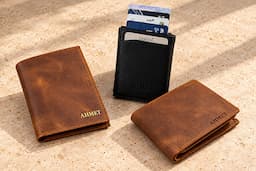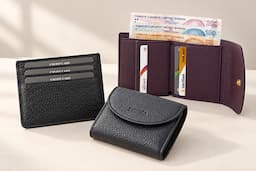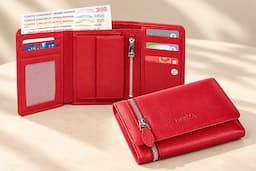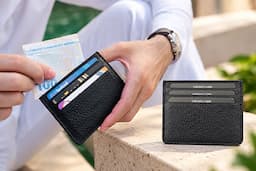

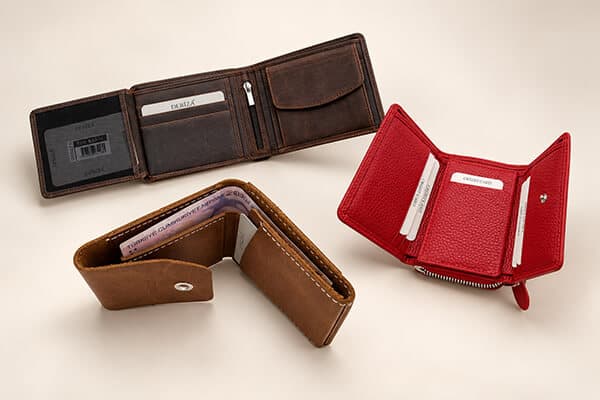
Where should you start when choosing a leather wallet?
Short answer: Start by listing the cards, banknotes, coins and documents you carry every day. Then consider the closed dimensions, compartments and filled thickness that suit where you carry your wallet. Check the leather, lining, stitching and closure details for the individual model. A suitable wallet lets you organise and access your everyday essentials without forcing them into place.
Before comparing leather wallet models, make a list of your needs. Two people carrying the same number of cards may need different wallets because they use cash differently or carry their wallets in different places.
1. List what you actually carry every day
Empty your current wallet and separate its contents by how often you use them. Keep everyday essentials distinct from accumulated receipts and rarely used cards.
- Cards: Which ID, driving licence, payment, travel and other cards do you need daily? Would you like separate access to the cards you use most?
- Banknotes: Do you carry cash only as a backup, or regularly pay with it and receive change?
- Coins and documents: Do you need a compartment that closes separately or a dedicated space for documents?
- Phone: Do you need to carry it inside your wallet, or would carrying it separately suit your routine better?
Carrying few cards does not automatically mean you need a card holder. If you also use banknotes and coins regularly, a wallet with the appropriate compartments may be more suitable.
2. Choose the size around your pocket or bag
Check the wallet’s closed width, height and stated thickness. Make sure the measurements refer to the open or closed product as appropriate. For a front pocket, consider its depth and opening. For a bag, consider the space remaining with your other belongings inside and how easily you can remove the wallet.
Measuring your current wallet with its usual contents can help you interpret a new model’s dimensions. However, empty thickness is not filled thickness. Cards, folded notes, coins, flaps and overlapping components all affect bulk. The terms “mini” and “slim” do not guarantee comfortable carrying.
External dimensions do not show the usable space inside. Seams, edges and folds take up room, so banknote or phone fit requires a separate assessment of the relevant compartment.
3. Choose the compartments and access you need
Read the number of card slots separately from the manufacturer’s stated capacity. Thick or embossed cards can change how the contents fit; do not force extra cards into a slot. Consider whether reaching a frequently used card requires removing everything or opening several sections.
If you prefer to carry banknotes unfolded, compare your currency’s note sizes with the usable internal space. For coins, look for a compartment designed to hold them and keep them enclosed. Not every zipped pocket is a coin compartment; a zip may close the entire wallet or only an internal pocket.
When choosing between a press stud, magnet, zip or folding design, consider whether the wallet closes comfortably with your daily contents. The closure alone does not prove capacity, quality or waterproofing.
4. Read leather, lining and construction details together
“Genuine leather” describes a material; it is not a quality grade or a guarantee of service life. Check the leather type, surface finish and other materials used in the model. If one product specifies cowhide, do not assume the entire collection uses the same material. A leather exterior does not mean that every internal component is also leather.
The outer body, card pockets and banknote compartments overlap. Component thickness, controlled thinning, folds and layout affect the wallet’s bulk. Thicker leather or additional stitching does not produce a better result in every part of a wallet.
When inspecting a product, look at stitch consistency, pocket alignment, edge finishing and how neatly the lining sits. Consider additional features such as RFID protection only when they are explicitly specified for that model.
5. A short decision tree for choosing your wallet
Answer these questions in order. You may answer “yes” to more than one; the model you choose should meet those needs together.
- Will you carry your phone inside the wallet? If yes, first assess your phone’s dimensions with its case, the usable compartment space, the opening and closure with the wallet filled. The phone wallet sizing guide explains these checks. If not, a phone compartment does not need to be on your essential features list.
- Do you regularly carry coins? If yes, consider models with a dedicated coin compartment. If not, decide whether you need that compartment at all.
- Do you frequently take out banknotes? If yes, prioritise easy removal and replacement. If cash is only a backup, check how notes must be folded and how much thickness they add.
- Are cards the main things you carry? If yes, consider both card holders and compact wallets. The card holder and wallet comparison also accounts for cash and additional compartment needs.
- Does the chosen design suit where you carry it? Check closed dimensions and information about filled use. If fitting your essentials or closing the wallet requires force, consider a different size or compartment layout.
6. Which detailed guide will help you?
- Horizontal or vertical designs and pocket carrying: The men’s leather wallet selection guide considers closed dimensions, card layout and carrying habits together.
- Mini, long or large wallets and bag organisation: The women’s wallet size and compartment guide helps you assess storage needs alongside organisation.
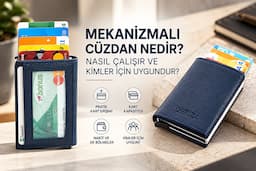
- Accessing cards through a mechanism: The pop-up wallet guide explains card access, chamber capacity and additional compartments.
A men’s or women’s category label does not determine how practical a wallet will be for you. Use the guides according to the shape, compartments and carrying method you need.
7. Three everyday needs, three different priorities
The examples below are selection scenarios, not product tests or customer experiences.
| Everyday need | Selection priority |
|---|---|
| Few cards, regular cash payments and change | Banknote access and a separate coin compartment. Do not decide solely by card count. |
| Mainly cards, carried in a narrow front pocket | Closed dimensions, filled thickness and access to frequently used cards. |
| Cards, notes and receipts carried in a small bag | A size that suits the bag’s usable space and the compartments needed to separate your belongings. |
Mistakes to avoid when choosing a wallet
- Deciding only from a product photo or the labels “mini”, “large” and “slim”.
- Treating the number of card slots as tested total capacity.
- Inferring banknote or phone fit from external dimensions.
- Choosing unnecessary compartments simply because there are more of them.
- Inferring service life, RFID protection or waterproofing from the leather type.
Complete your choice with colour, gifting and care considerations
Choose the colour and surface appearance from models that meet your practical needs. When buying a gift, consider the recipient’s carrying habits too. If you want a name or initials added, check that the option is available for the chosen model.
Follow the manufacturer’s care instructions for the leather and finish. Avoid intense heat and do not rapidly dry a wet wallet with a heat source. Do not apply random oils or household cleaners. Test a suitable care product on a small concealed area first, and do not fill the wallet beyond its stated capacity.
Compare models against your needs list
Finally, compare shortlisted models using the same list: card and cash organisation, closed dimensions, filled use, material information and ease of access. If a measurement or capacity detail is missing, request model-specific information rather than guessing.
Compare suitable models using their dimensions and compartment details. Base your choice on how comfortably you can organise, carry and retrieve your everyday essentials.






Merhaba Deri Tutkunları!
Ben Recep AYCAN, Ege Üniversitesi Deri Mühendisliği mezunu bir deri mühendisiyim. 🎓 Bu blog sayfasında, deriyle ilgili merak edilen her şeyi, en detaylı ve keyifli şekilde sizlerle paylaşacağım. Umarım içeriklerimden keyif alırsınız! 😊 📧 Bana Ulaşın Sorularınız için her zaman destek@deriza.com adresinden bana yazabilirsiniz. Keyifli okumalar dilerim!