How to Tell If a Leather Jacket Is Genuine?
Quick Answer: How Can You Tell If a Leather Jacket Is Genuine?
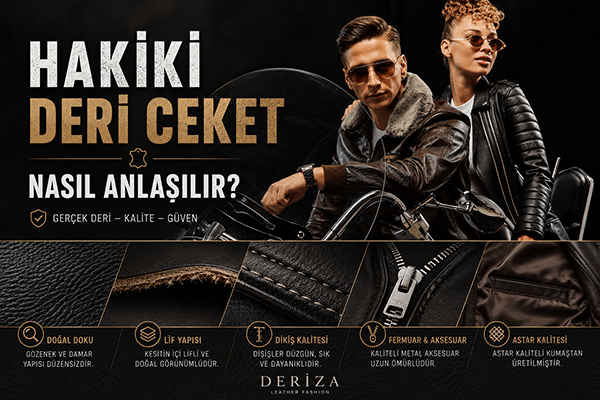
To identify a genuine leather jacket, it is not enough to rely only on smell, softness, pores or a water-drop test. A more reliable evaluation starts with checking the product's material description and label, reviewing the manufacturer's information, examining the leather surface and, where possible without damaging the product, looking at a naturally visible edge or cross-section. There is no single consumer test that universally proves that leather is genuine.
It is also important to separate two different questions: “Is the jacket genuine leather?” concerns what the material is; “Is it a high-quality jacket?” concerns the leather quality together with cutting, stitching, lining, zippers, fit and overall garment construction.
Modern synthetic materials can reproduce the appearance and some tactile characteristics of natural leather very effectively. For this reason, it is not always possible to make a reliable judgement based only on a photograph, the first touch or the smell of a jacket.
The question how can you tell if a leather jacket is genuine? should therefore be answered by evaluating several pieces of information and physical clues together rather than relying on one test.
What Is Genuine Leather?
Genuine leather is produced by tanning natural animal hide to make it stable and usable, followed by processes such as dyeing, fatliquoring and finishing according to the intended application.
Leather naturally has a three-dimensional fibrous structure. However, the appearance and physical properties of finished leather do not depend only on the animal species. Raw hide selection, fibre structure, thickness, tanning, fatliquoring, dyeing and finishing all contribute to the final character of the material.
For this reason, “genuine leather” is not a detailed quality grade. Two jackets can both be made from genuine leather and still differ considerably because of leather selection, processing and garment manufacturing quality.
What Should You Check to Identify Genuine Leather?
| Check | What Does It Show? | Conclusive on Its Own? |
|---|---|---|
| Material information and label | The material declared by the manufacturer | One of the most important starting points |
| Manufacturer / seller information | How clear and consistent the material claim is | Should be considered together with other information |
| Surface and grain | Clues about natural leather character and finishing | No |
| Pore appearance | Information about surface structure | No |
| Edge / cross-section | A strong clue about fibre and layer structure | May not be visible on every product |
| Touch and hand feel | The tactile character of the material | No |
| Smell | May provide a supporting clue | No |
| Stitching and workmanship | Information about manufacturing quality | Does not prove that the leather is genuine |
1. Start With the Label and Material Description
Especially when shopping online, the first thing to check should not be a physical “leather test”, but the material information provided for the product.
The product description should clearly state the material used. Terms such as “genuine leather” or “real leather” indicate natural leather, while “synthetic leather”, “PU”, “faux leather” or “leather-look” refer to different material structures.
However, a label that simply says “genuine leather” does not provide detailed information about leather type, selection, finishing or overall manufacturing quality.
Leather Engineer's Note: Genuine Leather Is Not a Quality Grade
“Genuine leather” primarily means that the material is natural leather. Even two jackets made from the same general leather type can behave differently because of raw hide selection, fibre structure, thickness, tanning, fatliquoring, dyeing, finishing, cutting and manufacturing quality.
For this reason, the authenticity of the material and the quality level of the finished garment should be evaluated separately.
2. Examine the Surface and Grain Structure
Natural leather is a material of biological origin. Variations in texture, grain, pores or colour may therefore appear on the surface.
However, not every genuine leather surface has to look noticeably irregular. Dyeing, embossing, coating and other finishing processes can significantly change the appearance of the leather. Some genuine leathers may look very uniform.
Conversely, synthetic materials can also be produced with surface patterns that imitate natural leather.
Therefore, the simple rule “an irregular surface is genuine, a perfect surface is synthetic” is not reliable.
3. Do Pores Prove That Leather Is Genuine?
No. Pore structure can support the evaluation, but it is not proof on its own.
The pore distribution on the grain surface of natural leather may not show perfectly mechanical repetition. However, leather-like pore patterns can also be applied to synthetic materials, while genuine leather can appear quite uniform after finishing.
Pores should therefore be treated as a supporting surface clue.
4. Why Is the Edge or Cross-Section Important?
If the construction of the jacket naturally leaves an edge or cross-section visible, this area can provide a useful physical clue about the material structure.
Genuine leather has a three-dimensional fibrous structure. In an appropriate exposed cross-section, this fibre structure may be visible. Some synthetic leather constructions may instead include a textile-based backing with a polymer-based surface layer.
However, jacket edges are often folded, painted or enclosed within the lining, so an exposed cross-section may not be available on every product. You should never cut, dismantle or damage a jacket just to inspect the material.
5. Can You Identify Genuine Leather by Touch?
Touch can provide useful information about leather, but it cannot provide a definitive answer on its own.
In the leather industry, hand feel includes softness, fullness, flexibility, surface slip and the overall tactile character of the material.
For example, lamb leather can offer a relatively soft, lightweight and supple character. However, this does not mean that “if it is soft, it must be genuine”. Modern synthetic materials can also be engineered with sophisticated tactile properties.
Likewise, a firmer or more structured genuine leather may be completely appropriate for a particular design.
6. Is the Smell Test Reliable?
Smell alone is not a reliable test for genuine leather.
Leather may have a characteristic smell, but tanning, dyeing, fatliquoring, finishing, packaging and storage can all influence the smell of the finished product.
Synthetic materials can also have noticeable odours depending on the components used in production. For this reason, “it smells like leather, so it must be genuine” is not a reliable conclusion.
7. Does the Water-Drop Test Prove Genuine Leather?
A common online method is to place a drop of water on the leather. However, this is not a reliable consumer test that conclusively proves genuine leather.
Leather's behaviour toward water can vary according to the surface finish. Genuine leather with a protective or water-repellent finish may not absorb water immediately. Uncontrolled water application can also leave marks or alter the appearance of certain surfaces.
Instead of applying water to the product, it is more appropriate to evaluate the material information together with other physical clues.
8. Should You Use a Flame or Lighter Test?
No. Do not test a leather jacket with flame or high heat.
High temperatures can damage the leather surface, finish, colour, stitching, lining and other components of the garment. A jacket is also not made entirely of leather.
There is no need to damage a product in order to determine whether its leather is genuine.
9. Key Differences Between Genuine and Synthetic Leather
| Feature | Genuine Leather | Synthetic Leather |
|---|---|---|
| Basic structure | Natural three-dimensional fibre structure | Synthetic structure; may include backing and surface layers depending on the material |
| Surface | May show natural characteristics; appearance can be modified by finishing | Can be produced to imitate natural leather |
| Pores | May be related to the natural grain structure | Can be applied as a surface pattern |
| Cross-section | A fibrous structure may be visible | Layers may be visible depending on the material construction |
| Hand feel | Varies according to leather type and processing | Can vary depending on material technology |
| Verification | Material information and several independent clues should be evaluated together instead of relying on one physical test. | |
10. Does Genuine Leather Automatically Mean a High-Quality Jacket?
No. Genuine leather identifies what the material is; it does not define the complete quality level of the finished jacket.
When evaluating overall jacket quality, also consider:
- leather type and selection,
- thickness and hand feel appropriate for the design,
- finishing,
- cutting and panel placement,
- fit,
- stitching and joins,
- lining,
- zippers and hardware,
- suitability for the intended use.
For a more detailed buying guide, see What to Look for When Buying a Leather Jacket?
Leather Engineer's Note: Separate Authenticity From Quality
Determining whether a material is genuine leather concerns material identity. Evaluating whether a leather jacket is high quality involves the material together with finishing, cutting, fit, stitching, lining, zippers and overall garment construction.
Separating these two questions leads to a more accurate leather jacket evaluation.
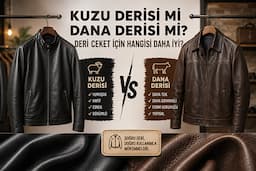
11. Lamb Leather or Cowhide?
Lamb leather and cowhide are both natural leather types, but they do not necessarily have the same physical characteristics.
Lamb leather can generally offer a relatively soft, lightweight and supple character in leather apparel. Cowhide, depending on selection, thickness and processing, can offer a firmer and more structured character.
However, it is not correct to describe one as universally “higher quality”. The appropriate leather depends on the design of the jacket, the required handle and intended use.
For a detailed comparison, see Lamb Leather vs Cowhide: Which Is Better?
12. How Can You Check a Genuine Leather Jacket When Shopping Online?
When shopping online, you cannot physically handle the leather, so the quality and transparency of the product information become more important.
- Material: Is genuine leather clearly stated?
- Leather type: Is information provided about the leather used?
- Product photos: Are there close-up images showing the surface and manufacturing details?
- Manufacturer information: Is the material description clear and consistent?
- Technical details: Are lining, closure, fit and other product details explained?
- Actual garment measurements: Are physical measurements provided for the specific model?
- Returns and exchanges: Are the conditions clear if you want to evaluate the product after delivery?
When shopping online, consider material declaration + product information + manufacturer transparency together rather than relying only on images.
13. Does Price Prove That Leather Is Genuine?
No. The raw material and production structure of genuine leather products may differ from synthetic alternatives, but a high price alone does not prove that a product is genuine leather or high quality.
Likewise, a low price does not automatically mean that a product is synthetic. Promotions, stock, production structure, design and other commercial factors can influence price.
Genuine Leather Jacket Checklist
- □ Does the material description clearly state genuine leather?
- □ Is information provided about the type of leather used?
- □ Does the manufacturer or seller provide clear and consistent material information?
- □ Has the surface been evaluated while considering the effect of finishing?
- □ Were pores avoided as a standalone proof of authenticity?
- □ If naturally visible, was the edge or cross-section examined without damaging the garment?
- □ Were smell and touch treated only as supporting clues?
- □ Were potentially damaging tests such as water or flame avoided?
- □ Were material authenticity and overall garment quality evaluated separately?
Deriza's Approach to Genuine Leather Jackets
Deriza predominantly uses genuine lamb leather in its leather apparel collections. However, we do not consider the words “genuine leather” alone sufficient when evaluating a jacket.
In addition to material identity, leather selection, finishing, cutting, fit, stitching, lining, zippers and overall garment construction all contribute to the wearing characteristics of the finished jacket.
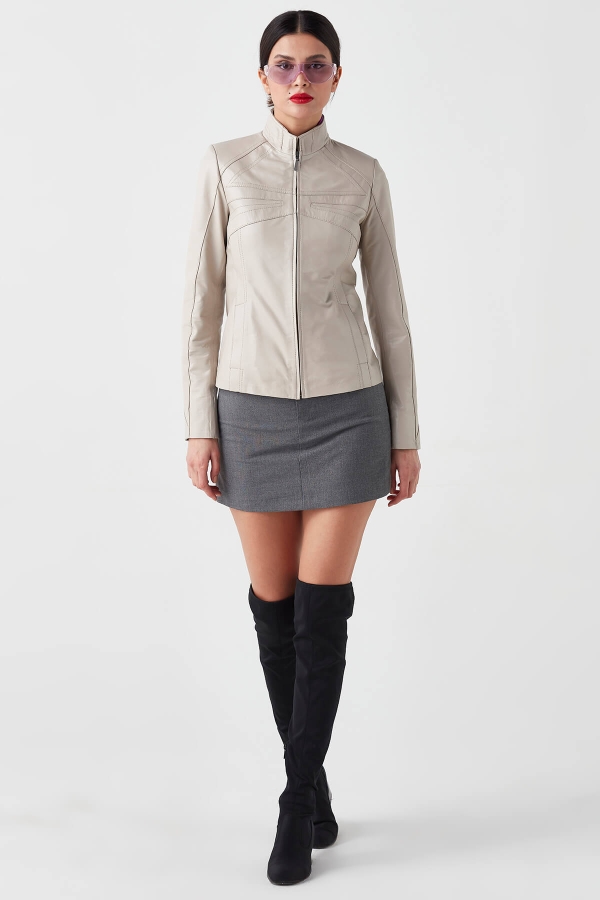
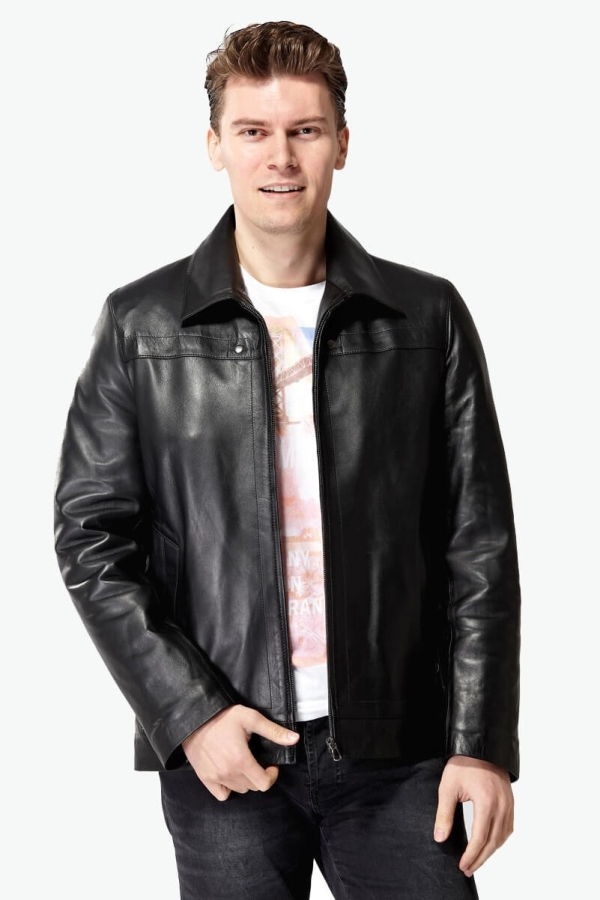
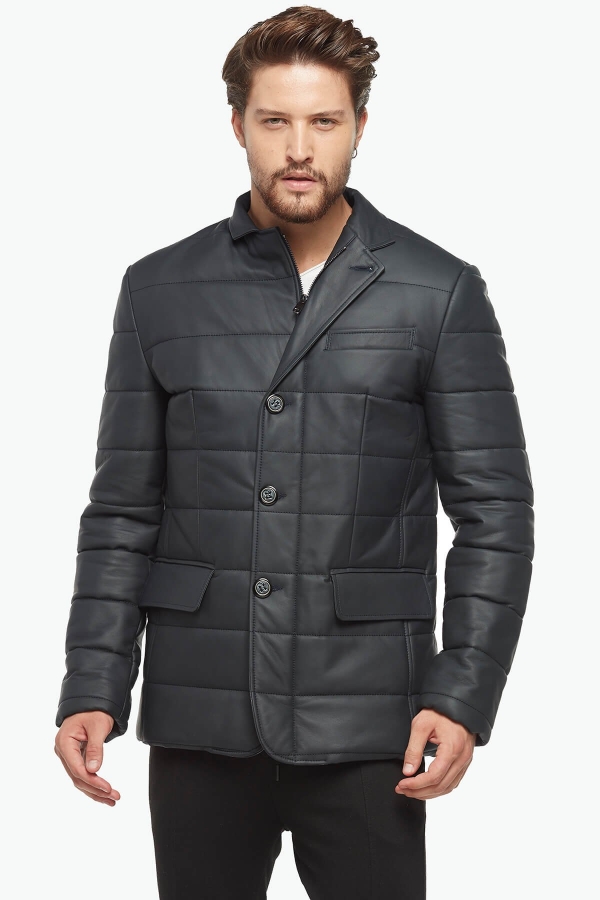
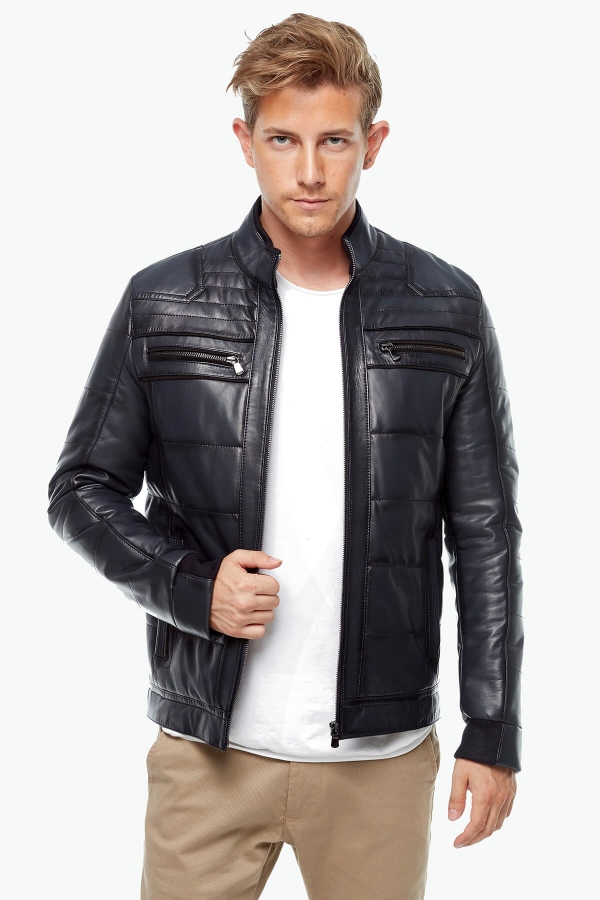
To compare men's and women's styles together, explore the Genuine Leather Jacket collection; for gender-specific styles, see Men's Leather Jackets and Women's Leather Jackets.
Frequently Asked Questions
How can you tell if a leather jacket is genuine?
Start with the material description and label, then evaluate the surface, pores, hand feel and, where naturally visible, the edge or cross-section. It is not reliable to make a definitive decision based on one physical sign alone.
Can you identify genuine leather by smell?
No. Leather may have a characteristic smell, but dyeing, finishing, packaging and storage can change the smell of the finished product. Smell should only be treated as a supporting clue.
Can you identify genuine leather from its pores?
Pore structure can help, but it is not enough on its own. Leather-like patterns can be applied to synthetic materials, while genuine leather may appear very uniform after finishing.
Is the water-drop test reliable?
No. Genuine leather's reaction to water can vary according to the finish, and water may leave marks on some surfaces. The water-drop test should therefore not be used as a conclusive verification method.
Should genuine leather be tested with fire?
No. Flame or high heat can damage the leather surface, finish, colour and other components of the jacket.
Does genuine leather mean the jacket is high quality?
No. Genuine leather identifies the material. Overall jacket quality also depends on leather selection and finishing, cutting, fit, stitching, lining, zippers and construction.
Is lamb leather better than cowhide?
Neither is universally better. Lamb leather can generally offer a relatively soft and lightweight character, while cowhide can be firmer and more structured depending on processing. The right choice depends on the design and intended use.
Conclusion: Do Not Evaluate Genuine Leather With a Single Test
The reliable answer to how to tell if a leather jacket is genuine does not depend on a single sign such as smell, pores, touch or water.
Start with the material description and label. Then evaluate the manufacturer information, leather surface, pores, hand feel and, where naturally visible without damaging the garment, the edge or cross-section.
Finally, separate “is it genuine leather?” from “is it a high-quality leather jacket?” The first concerns material identity; the second also includes leather quality, finishing, cutting, fit, stitching, lining, zippers and overall construction.
To compare different men's and women's styles, explore the Deriza Genuine Leather Jacket Collection.




.jpg&w=256&q=75)