
How to Tell If a Leather Jacket Is Genuine? Real Leather Guide
Quick Answer: How Can You Tell If a Leather Jacket Is Genuine?
To identify a genuine leather jacket, it is not enough to rely only on smell, pores, softness or a water-drop test. A more reliable approach is to first check the product's material description and label, evaluate the manufacturer information, and then examine the leather surface, natural texture and, where visible, the edge or cross-section of the material. Smell, water absorption, pores or softness alone are not conclusive tests for genuine leather.
It is also important to separate two different questions: “Is this jacket made of genuine leather?” concerns the identity of the material, while “Is this a high-quality leather jacket?” concerns the leather, finish, cutting, fit, stitching, lining, zippers and overall construction of the garment.
One of the most important questions when buying a leather jacket is whether the product is actually made from genuine leather. Modern synthetic materials can reproduce the appearance and even some tactile characteristics of natural leather very effectively, so it is not always possible to make a reliable judgement from a photograph or first touch alone.
Instead of relying on one-step “leather tests” commonly found online, it is more reliable to evaluate several independent indicators together.
What Is a Genuine Leather Jacket?
A genuine leather jacket is an outerwear garment made from natural animal hide that has been tanned, dyed and finished as required for apparel use before being cut and sewn according to the jacket pattern.
However, “genuine leather” is not a detailed quality grade. Two jackets can both be made from genuine leather while differing considerably in leather type, selection, thickness, fibre structure, surface treatment, finishing and garment construction.
Deriza predominantly uses genuine lamb leather in its leather apparel collections. The relatively soft, lightweight and supple character of lamb leather can be advantageous for movement and for different jacket constructions. However, the words “lamb leather” alone do not define the overall quality of a product.
To compare genuine leather outerwear, explore the Leather Jacket collection.
Which Checks Are More Useful When Identifying Genuine Leather?
| Check | What Does It Show? | How Should It Be Used? |
|---|---|---|
| Material description and label | The material declared by the manufacturer | One of the first points to check |
| Manufacturer / seller information | Transparency and consistency of the material claim | Especially important when shopping online |
| Surface and grain | Clues about natural leather character and finishing | Not conclusive on its own |
| Pore appearance | Clues about surface structure | Can be imitated on synthetic surfaces |
| Visible edge / cross-section | Information about fibre and layer structure | A useful physical clue when naturally visible |
| Hand feel | The tactile character of the material | Supporting evidence, not proof |
| Smell | A possible supporting clue | Not reliable on its own |
| Stitching and workmanship | Information about garment manufacturing quality | Does not prove that the leather is genuine |
1. Start With the Label and Material Description
Especially when shopping online, the first check should not be a physical “leather test”; it should be the material information provided for the product.
The product description should clearly state the material used. Terms such as “genuine leather” or “real leather” indicate natural leather, while “faux leather”, “synthetic leather”, “PU leather” or “leather-look” describe different material structures.
However, a label that simply says “genuine leather” does not by itself explain the leather type, its quality, surface treatment or the manufacturing quality of the jacket.
Leather Engineer's Note: Genuine Leather Is Not a Quality Grade
“Genuine leather” primarily identifies the material as natural leather. Two jackets made from the same general leather type can behave very differently because of raw hide selection, fibre structure, thickness, tanning, fatliquoring, dyeing, finishing, cutting and garment construction.
For this reason, material identity and product quality should be evaluated separately.
2. Examine the Surface and Grain Structure
Natural leather is a material of biological origin. Small variations in texture, grain, pores and colour may therefore be present on the surface.
However, not every genuine leather surface has to look visibly irregular. Dyeing, embossing and finishing can significantly alter the appearance of the leather, and some genuine leathers can have a highly uniform surface.
Conversely, synthetic materials can be manufactured with patterns that successfully imitate natural leather.
Therefore, there is no reliable rule that says “an irregular surface is genuine and a perfect-looking surface is synthetic.”
3. Do Pores Prove That Leather Is Genuine?
No. Pore structure can provide useful information, but it is not proof on its own.
The grain and pore distribution of natural leather may not show perfectly mechanical repetition. However, leather-like pore patterns can also be embossed onto synthetic materials, while finishing treatments can make genuine leather surfaces appear much more uniform.
It is therefore better to treat pores as a supporting surface clue rather than proof.
4. Why Can the Edge or Cross-Section Be Useful?
If the construction of the garment naturally leaves an edge or cross-section visible, it can provide useful physical information about the material.
Natural leather has a three-dimensional fibrous structure. This fibre network may be visible in an appropriate exposed cross-section. Some synthetic leather constructions, by contrast, may show a textile backing with a polymer-based surface layer.
Leather Engineer's Note: Look Beyond the Surface
Surface appearance can be changed by finishing and can also be imitated by synthetic materials. A cross-section can provide more direct information about the internal structure of the material.
However, jacket edges are often folded, painted or enclosed within the lining. You should never cut, dismantle or damage a garment just to expose a cross-section.
5. Can Touch and Hand Feel Identify Genuine Leather?
In the leather industry, hand feel describes how a material feels when handled. Softness, fullness, flexibility, surface slip and overall handle are all part of this evaluation.
Genuine lamb leather can have a soft and supple character. However, “if it feels soft, it must be genuine leather” is not a reliable conclusion. Modern synthetic materials can also be engineered with sophisticated tactile properties.
Likewise, genuine leather may have a firmer or more structured feel depending on the intended use of the garment.
6. Is Smell a Reliable Genuine Leather Test?
No.
Natural leather may have a characteristic smell, but the final scent of a product can be influenced by tanning, dyeing, fatliquoring, finishing, packaging and storage conditions. Synthetic materials can also carry distinctive smells resulting from their manufacturing processes.
For this reason, “it smells like leather, so it must be genuine” is not a reliable verification method.
7. Is the Water-Drop Test Reliable?
One common online suggestion is to place a drop of water on the surface. However, genuine leather's behaviour toward water can vary significantly depending on the surface finish.
Genuine leather treated with protective or water-repellent finishing may not absorb water immediately. At the same time, uncontrolled water application may leave a mark or alter the appearance of some leather finishes.
Therefore, the water-drop test is not a conclusive or recommended method for verifying a genuine leather jacket.
8. Should You Use a Flame or Lighter Test?
No. A leather jacket should not be exposed to flame or high heat as a test.
Heat can damage the leather, finish, colour, stitching and other components of the garment. A jacket is also not made entirely of leather; it can contain lining, thread, insulation and various accessories.
There is no need to damage a purchased garment in order to verify whether the leather is genuine.
9. Are Natural Surface Variations a Sign of Quality?
Because genuine leather is a natural material, slight variations in grain, texture, pores or colour may occur.
However, two extreme conclusions should be avoided:
- Not every natural variation should be treated as a defect.
- Not every irregularity should automatically be treated as proof of high quality.
Natural leather character should be distinguished from scratches, colour loss, finishing problems, production defects or wear damage.
10. Does Genuine Leather Automatically Mean a High-Quality Jacket?
No. Genuine leather and a high-quality leather jacket are not the same thing.
The genuine leather description identifies the material. The quality of the finished jacket requires a broader evaluation.
The following factors should be considered together:
- Leather type and quality
- Thickness and handle appropriate for the design
- Surface and finishing
- Panel selection and cutting
- Fit and pattern
- Stitching and seam construction
- Lining
- Insulation, where present
- Zippers and buttons
- Hardware attachment
- Pockets and other construction details
Leather Engineer's Note: Separate Authenticity From Quality
Determining whether a material is genuine leather concerns material identity. Determining whether the finished jacket is high quality concerns the entire relationship between the material and garment construction.
Leather + finishing + cutting + fit + stitching + lining + hardware + construction should be evaluated together.
11. Do Stitching and Workmanship Prove That the Leather Is Genuine?
No. A synthetic jacket can be very well made, while a genuine leather jacket can have poor workmanship.
Stitching and workmanship should therefore be used to evaluate manufacturing quality, not to determine whether the material itself is genuine leather.
Pay particular attention to:
- consistency of stitching,
- panel joins,
- pocket areas,
- zipper attachment,
- collar and cuff construction,
- lining attachment.
12. Why Should You Check the Lining, Zippers and Hardware?
A genuine leather outer surface does not automatically mean that the whole jacket is well made. Zippers are opened and closed repeatedly, pockets carry loads, the lining is in constant contact with the body and clothing, and hardware attachment points are exposed to mechanical stress.
A good leather jacket therefore requires the material and construction to work together.
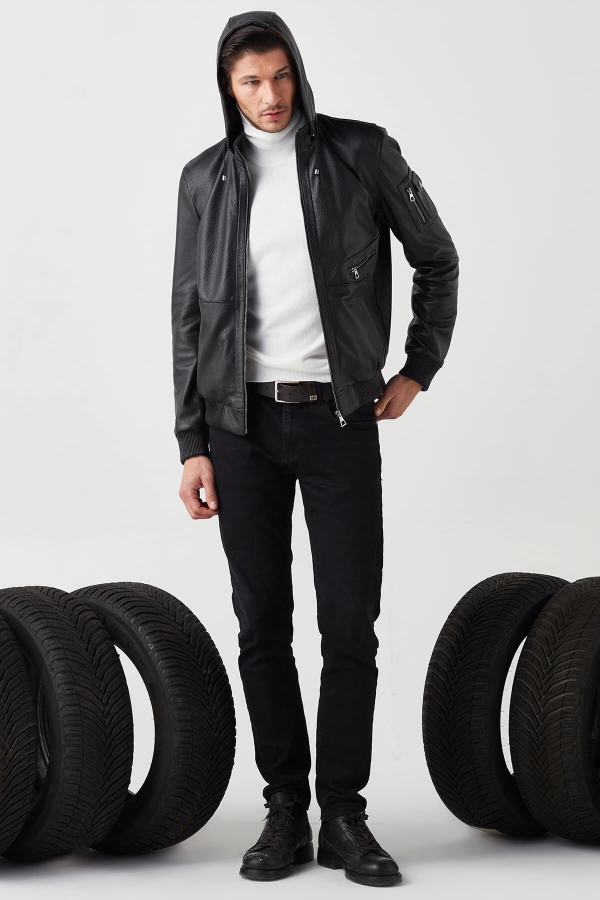
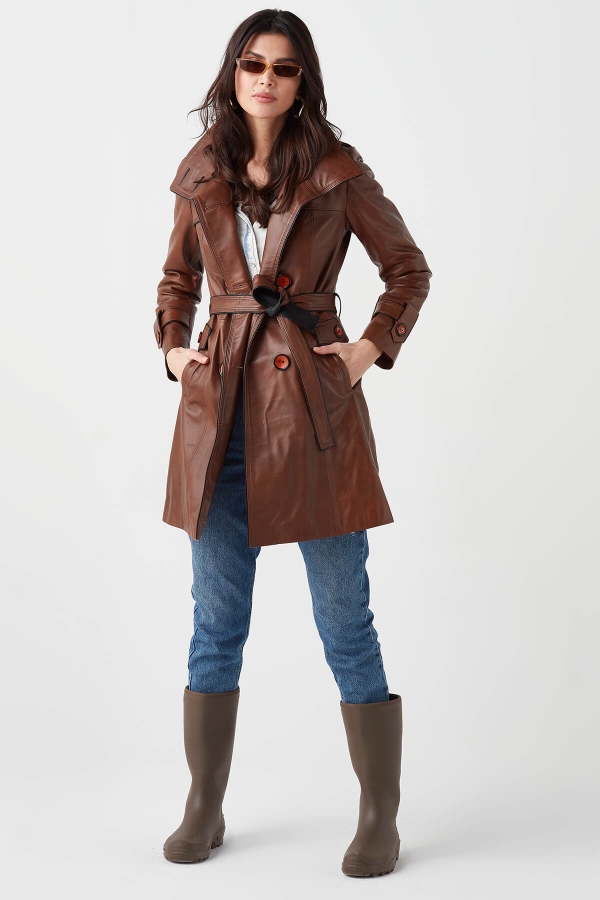
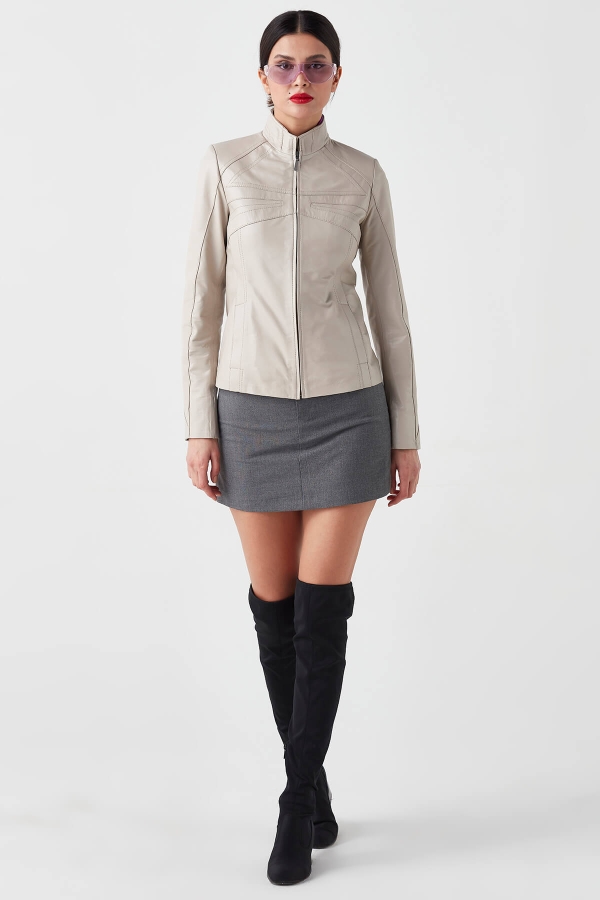
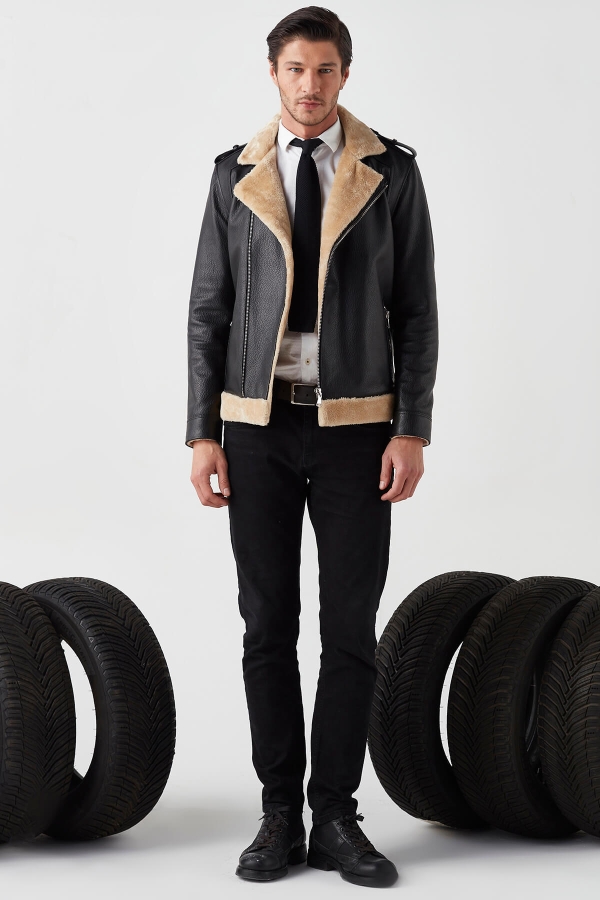
For men's styles, explore Men's Leather Jackets, and for women's styles, Women's Leather Jackets.
13. How Can You Check a Genuine Leather Jacket When Shopping Online?
When shopping online, physical checks such as smell, hand feel and cross-section are naturally limited. Instead of trying to perform a “leather test” through a screen, evaluate the transparency and consistency of the product information.
- Material: Is genuine leather clearly stated?
- Leather type: Is information provided about the type of leather used?
- Product images: Are close-up views of the leather surface and workmanship available?
- Technical details: Are the lining, insulation, closure and model features explained?
- Manufacturer / seller: Is the information about the material clear and consistent?
- Garment measurements: Can you access actual measurements for the specific model?
- Returns and exchanges: Are the conditions clear if you want to evaluate the product physically after delivery?
When buying online, consider material declaration + technical product information + manufacturer transparency together rather than relying only on product photography.
14. Does Price Prove That Leather Is Genuine?
No. The raw material and manufacturing structure of genuine leather products may differ from synthetic alternatives, but a high price alone does not prove that a jacket is genuine or high quality.
Likewise, a low price alone does not prove that the product is synthetic. Promotions, stock levels, manufacturing structure, design and other commercial factors can influence price.
For a more detailed explanation, read What Determines Leather Jacket Prices?.
Key Differences Between Genuine Leather and Synthetic Leather Jackets
| Feature | Genuine Leather | Synthetic Leather |
|---|---|---|
| Basic structure | Natural three-dimensional fibre structure | Synthetic and potentially layered structure depending on material type |
| Surface | May show natural character; appearance can be significantly altered by finishing | Can be manufactured to imitate natural leather |
| Pores | May reflect the natural structure | Can be embossed or printed onto the surface |
| Cross-section | A fibrous structure may be visible | Backing and coating layers may be visible depending on construction |
| Smell | May have a characteristic smell | Can have different odours depending on materials and manufacturing |
| Verification | Material information and several independent indicators should be evaluated together rather than relying on one consumer test. | |
Which Popular Leather Tests Should You Treat With Caution?
- “Smell it and you will know immediately”: Smell alone is not enough.
- “If it absorbs water, it is genuine”: Finishing can change water behaviour.
- “If you can see pores, it is real”: Pore patterns can be imitated on synthetic materials.
- “If it is soft, it is genuine”: Both natural and synthetic materials can have different hand feels.
- “If it is expensive, it is genuine”: Price does not prove material identity.
- “Test it with a lighter”: Do not use a method that can damage the garment.
The reliable approach is not to search for one magic test, but to evaluate several pieces of information together.
Genuine Leather Jacket Buying Checklist
Deriza's Approach to Genuine Leather Jackets
Deriza predominantly uses genuine lamb leather in its leather apparel collections. However, we do not consider the words “genuine leather” alone sufficient when evaluating a leather jacket.
The real wearing characteristics of a garment depend on the leather type and quality together with surface finishing, cutting, fit, stitching, lining, zippers, hardware and overall construction.
For a broader look at identifying genuine leather, read our How to Tell If a Leather Jacket Is Genuine guide; to compare leather types, see Lamb Leather vs Cowhide.
Frequently Asked Questions About Genuine Leather Jackets
How can you tell if a leather jacket is genuine?
Rather than relying on one test, evaluate the material description, label and manufacturer information together with the surface, hand feel and, where naturally visible, the material cross-section. Smell, water behaviour or pores alone are not conclusive.
Can you identify genuine leather by smell?
No. Smell can be a supporting clue but is not a conclusive verification method. Tanning, finishing, packaging and storage can all influence a product's smell.
Does genuine leather absorb water?
Water behaviour varies with the surface finish. Some genuine leathers may absorb water more readily, while protective finishes can delay absorption. The water test is therefore not conclusive.
Does genuine leather have visible pores?
Natural leather may show pore structure, but finishing can alter its appearance and similar patterns can be reproduced on synthetic surfaces. Pores alone are therefore not proof.
Are surface variations normal on genuine leather?
Slight variations in grain, texture, pores and colour can be part of natural leather. However, natural characteristics should be distinguished from scratches, colour loss or manufacturing defects.
Is every genuine leather jacket high quality?
No. Genuine leather describes the material. Overall quality also depends on leather selection, finishing, cutting, fit, stitching, lining, zippers, hardware and garment construction.
Should you use fire to test a leather jacket?
No. Flame or high heat can damage the leather surface, finish and other garment components. A burn test should not be used to verify genuine leather.
Conclusion: Evaluate Genuine Leather as a Whole, Not With One Test
The most reliable answer to how to tell if a leather jacket is genuine is not a single smell, water, pore or flame test.
Start with the material description and label. Evaluate the manufacturer information, then examine the surface, natural texture, hand feel and, where naturally visible, the edge or cross-section. Do not treat any one of these clues as universal proof.
Finally, separate genuine leather from the concept of a high-quality leather jacket. A complete quality assessment also includes finishing, cutting, fit, stitching, lining, zippers, hardware and construction.
To compare genuine lamb leather styles for women and men, explore the Deriza Leather Jacket Collection.

.jpg&w=256&q=75)